


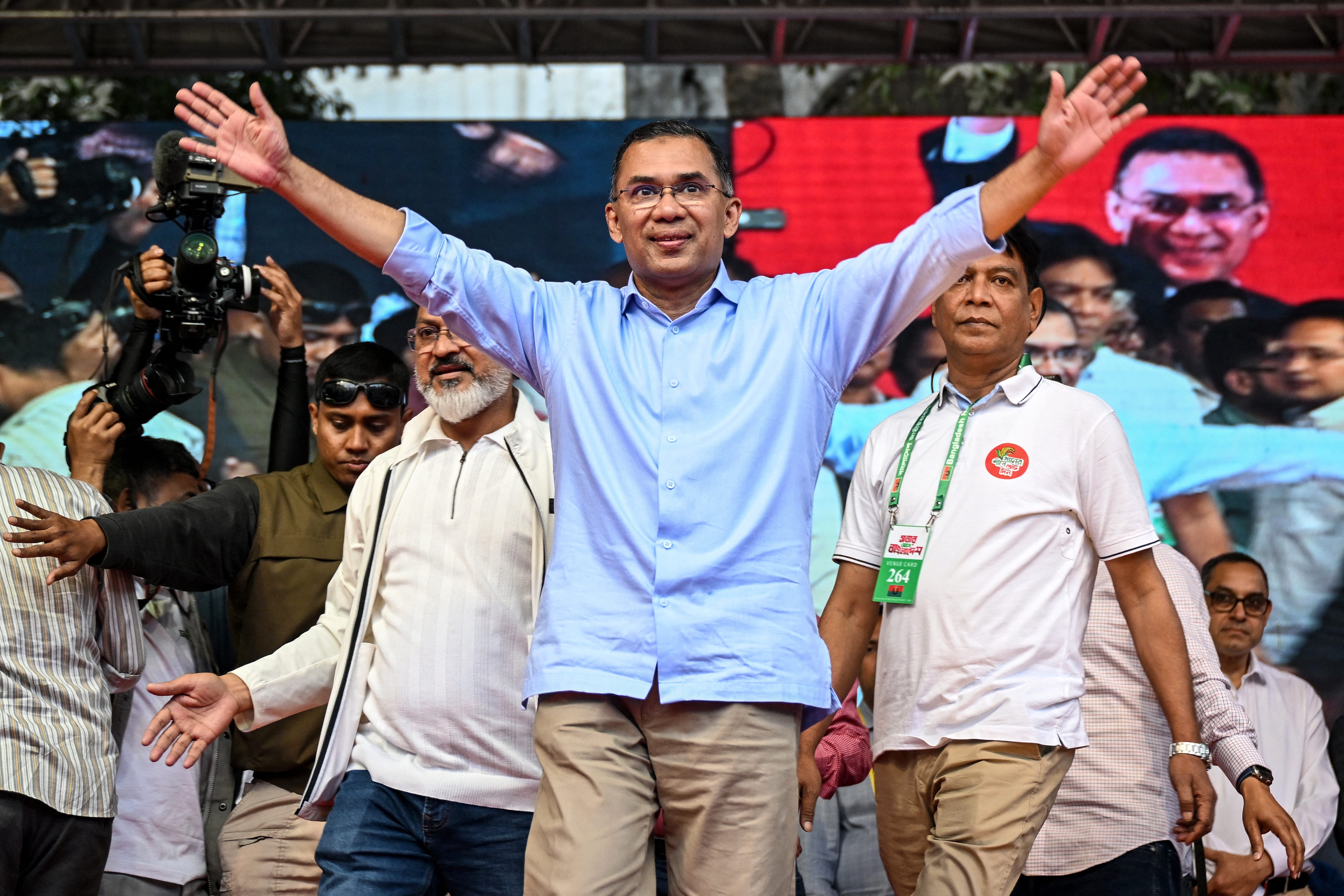
(Photo by Sajjad HUSSAIN / AFP via Getty Images)
The Bangladesh National Party (BNP) secured a sweeping majority in the February 12 general election, positioning its leader Tarique Rahman to form the next government and end more than a decade of dominance by former prime minister Sheikh Hasina’s Awami League. With voter turnout at 59.44 percent of roughly 127 million registered voters, the vote marked one of the most consequential and closely watched democratic exercises in Bangladesh’s recent history.
Despite a politically charged atmosphere and scattered reports of violence and electoral irregularities, the polls were broadly regarded as peaceful and credible. The Chief Adviser of Bangladesh’s caretaker government, Muhammad Yunus, framed the outcome as the “advent of a new Bangladesh.”
The election itself was born out of upheaval. The student-led July Movement of 2024—driven by Gen Z activists demanding accountability, fair elections, and institutional reform—precipitated the collapse of Hasina’s government that August. The February 12 election thus served not only as a transfer of power, but as a referendum on whether street protests and youth mobilization could translate into lasting change at the ballot box. Asia Society Policy Institute experts unpack what the election results mean in our latest edition of Asia ASAP.
BNP Claims a Decisive Mandate
- By Rishi Gupta
Sheikh Hasina’s Awami League was barred from contesting in the 2026 elections after being banned by the Yunus government. Hasina herself remains in exile in India, facing charges of crimes against humanity over her alleged role in a violent and deadly crackdown on the July protests. Without the Awami League, the February 12 contest emerged as one between the Bangladesh National Party (BNP) and Jamaat-e-Islami (JeI). The two parties have been key allies in the past and even formed a coalition government in 2001.
BNP party leader Tarique Rahman is the son of Khaleda Zia, who served as the prime minister during the 1991-1996 and 2001-2006 BNP-led governments. After two decades of self-imposed exile from Bangladesh, Tarique returned to Dhaka in December of 2025. Just two months later, he is poised to assume the position of prime minister—a remarkable feat.
So what helped the BNP win?
First, the BNP succeeded in diverting Awami League voters by presenting itself as a moderate and liberal front when comparted to Jamaat-e-Islami’s more radical Islamist ideology. Jel subtly advocated the implementation of Islamic laws and for a limited role for women in the workforce and the party’s leadership. While the party has emerged as the main opposition, its vision for Bangladesh does not align with the country’s cultural syncretism and secularism, something Hasina was credited with protecting. For an aspiring youth who led a movement against Hasina regime and toppled it, the Jamaat-led government would have been another challenge, taking the country backwards.
Second, the youth activists that led the Gen Z movement were expected to step into leadership roles after toppling the Hasina government. Unfortunately, youth leadership—despite the emergence of figures like Nahid Islam during the July Movement—failed to consolidate into a credible political alternative to BNP. After a brief role as an advisor in the Yunus-led interim government, Islam and his colleagues founded the National Citizens Party (NCP) in February 2025. But with only a year before the election to build a grassroots base, the NCP struggled to operate on its own. Instead, it decided to join hands with Jel in a risky political gamble that ultimately failed: Many of the young voters that made up the NCP’s base remain wary of JeI’s regressive approach towards girls and women. While Nahid secured a seat in Dhaka-11, his party remains in the single digits after contesting just 30 of the 299 seats up for grabs in Parliament.
Therefore, what might have been an opportunity for the Jel to present a reformist face instead became a setback for the NCP, allowing BNP to attract youth voters instead. For youth, this election presented an opportunity to build a Nooton Bangladesh (new Bangladesh), but choices before them were still limited to BNP and JeI, with NCP still struggling to define a viable national role.
Another factor that led to BNP’s success at the polls was their ability to consolidate the Hindu minority vote, which constitutes approximately 10% of the national total. Minorities have a key role in Dhaka’s political calculus and have been a stronghold for the Awami League, as Hasina was seen as a strong advocate of Bangladesh’s secular structure. However, violence against minorities in Bangladesh has remained a challenge, and, in the absence of the Awami League, minorities were wary of Jamaat’s hardline approach, opting instead the BNP.
With results out and BNP set to lead the new government, party leader Tarique Rahman will have a huge mandate to deliver, including reforms to the July Charter, which was put to a vote during the election. Voters responded positively to the charter’s implementation, and it is set to be put through a parliamentary process under the BNP government, which may further work on it before giving it a final nod. The mandate will play a key role in shaping Bangladesh’s religious outlook—between secularism and radical Islam—and will be impactful in shaping regional engagement, especially with India.
“Bangladesh First” Foreign Policy?
— By Farwa Aamer
Bangladesh has concluded one of its most consequential elections in decades, following the student-led July 2024 uprising and a fragile interim phase. That a reform-minded electorate returned a party rooted in dynastic politics is notable. But the mandate reflects fatigue with the previous order and a clear refusal to allow the far right to consolidate ground.
Foreign policy will test the new government’s maturity. Relations with India hit a nadir after Sheikh Hasina’s ouster and her continued presence there. The BNP’s almost “Bangladesh First” like rhetoric suggests repatriation demands and tougher positioning on border issues may remain in play. Yet geography imposes limits. The two countries share a long, porous border, energy interdependence, critical water-sharing frameworks, and substantial trade ties that anchor Dhaka to New Delhi. A pragmatic reset is in the interest of both sides. India has already signaled willingness to work with a newly elected government, and a proactive outreach to a BNP-led administration is likely.
With Pakistan, ties have been quietly warming. Trade has resumed and discussions around potential JF-17 procurement point to expanding defense cooperation. Bangladesh may find space to maintain workable relations with both India and Pakistan, balancing rather than choosing.
China will remain central. It is Bangladesh’s largest trading partner and has investments across infrastructure, energy, and industrial projects, alongside agreements supporting drone manufacturing. China has also benefited from any perceived vacuum in Western engagement, consolidating its footprint across South Asia. If India-Bangladesh ties remain strained, Beijing’s leverage will only grow.
That dynamic draws in the United States. Recent tariff reductions to 19 percent and duty-free access for apparel using U.S.-produced cotton and man-made fiber provide tangible relief to Bangladesh’s garment sector. The U.S. objective is clear: sustain commercial interdependence while limiting Dhaka’s structural drift toward Beijing.
Looking ahead, the new government’s task will be to leverage relations with all major powers to Bangladesh’s strategic advantage, while avoiding overreliance on any single partner.
Dive Deeper with ASPI:
Register for our upcoming webinar, “Bangladesh After the Vote: Democracy, Reform, and Foreign Policy Outlook”, which will be held from 9-10am EST on February 19. The panelists will include Dr. Fahmida Khatun, Dr. Sreeradha Datta, and Ambassador Shahed Akhter. Farwa Aamer will moderate.
Read Bryanna Entwistle’s analysis of February 8 Thai elections, “Establishment Forces Prevail as Thailand’s Progressives Fall Short.”
Read Hunter Marston’s coverage of the recent elections in Myanmar, “Military Elections Will Not Resolve Myanmar’s Deeper Problems”.