


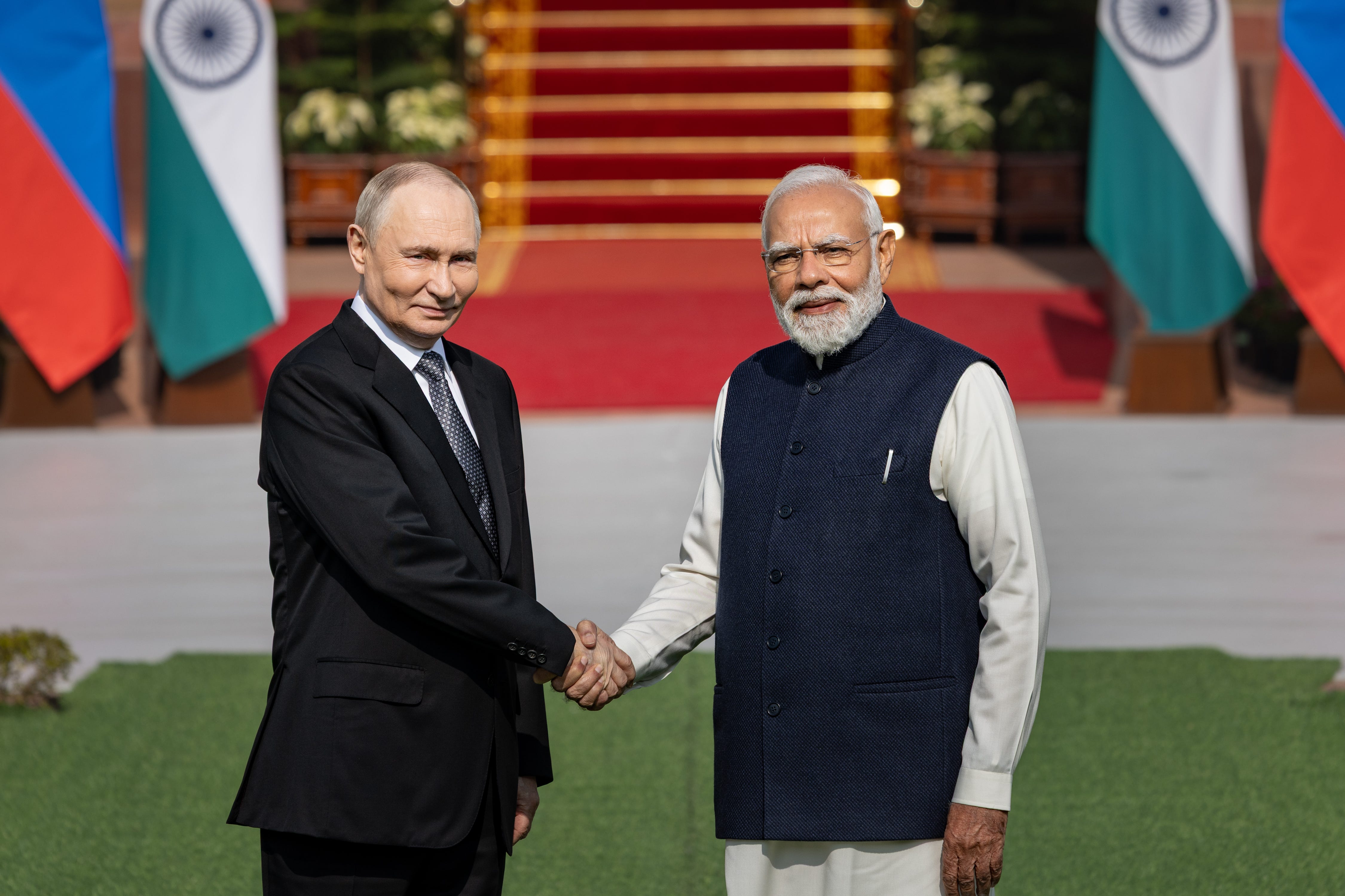
(Photo by Elke Scholiers/Getty Images)
What Happened
On Friday, December 5, Russian President Vladimir Putin visited New Delhi for an annual meeting between Russia and India, marking the first time that he has visited India since Russia’s invasion of Ukraine. The bilateral summit comes as Indian Prime Minister Narendra Modi navigates increasing pressure from the United States on Indian imports of Russian oil, reflecting New Delhi’s greater challenge of balancing its own strategic interests with those of its partners across the globe. The summit provided a platform for the two countries to reach a slew of economic and commercial agreements and showed that despite external pressures from Washington, neither India nor Russia has the intention to dilute their relationship.
In this edition of Asia ASAP, Asia Society Policy Institute (ASPI) experts provide their rapid reactions to the summit’s outcomes. Subscribe for access to more expert analysis of breaking news events across the Asia Pacific.
Modi’s Careful Strategic Calculus
By Farwa Aamer, Director of South Asia Initiatives
The Modi-Putin meeting became a test of how much strategic room India still has to balance between Washington and Moscow. India reduced some Russian oil inflows to ease tensions with Washington, yet it also needed to signal to Moscow that the partnership retains depth, particularly in people-to-people ties, defense cooperation, civil nuclear energy, and long-term economic planning.
The optics of the meeting were undoubtedly warm, and though the deliverables were more modest than anticipated, the clearest progress came in economic cooperation. The overall approach suggests that India is trying to preserve its relationship with Russia, while gradually reshaping it in ways that reduce exposure to sanctions and geopolitical shocks.
Pressure did not come from Washington alone. Several European capitals voiced unease in the lead-up to the summit, adding another layer of complexity. India does not want to dilute its ties with Russia, both to avoid appearing susceptible to Western pressure and to prevent Moscow from drifting further toward Beijing at a time when India’s own relationship with China remains complicated. Yet New Delhi also has a potential U.S. trade deal on the horizon and ongoing negotiations with the EU, both of which it cannot afford to jeopardize.
In the end, the Modi-Putin meeting captured the central dilemma of India’s foreign policy today. India wants to maintain a broad network of strategic partnerships, but doing so now requires far more careful calibration. The Russia relationship remains important, as do India’s economic and strategic ties with the West. The balancing act continues, but the frictions are more visible, and the space for smooth navigation is narrowing.
An Economic Summit in New Delhi
By Akshay Mathur, Senior Director, ASPI Delhi
This year’s India-Russia summit could be branded as an ‘economic summit.’ The launch of a new ‘Programme of Economic Cooperation’ as a roadmap to achieve the target of $100 billion in trade by 2030 defined the spirit of the negotiations.
For starters, fixing the trade imbalance is now a priority. Russia has had a $58.9 billion surplus with India in FY 2024-25—nearly one-fifth of India’s total trade deficit and second only to China. Going forward, Indian pharmaceutical, agricultural, and marine exports will be welcomed in Russia. Multiple references by both leaders to the FTA with the Eurasian Economic Union signaled their preferences for a regional approach towards trade.
At the Russia-India Business Forum, Prime Minister Modi made a clarion call to develop a “simplified, predictable mechanism” for conducting business, presumably to mitigate the sanctions imposed by the EU, UK and the United States. For instance, India cut oil from Russia by 38% in October 2025 as sanctions on Russian oil became stricter. The direct sanctioning of Nayara Energy, located in Gurjarat and in which Rosneft and other Russian companies have majority stakes, is also an area for concern for Delhi.
Therefore, it was no surprise that a focus of the meeting was on bilateral settlements through national currencies, interoperability of the national payment systems, financial messaging systems and central bank digital currency platforms, and mechanisms for insurance and reinsurance. President Putin reminded New Delhi that 96% of trade is already being settled through national currencies: Sber, a Russian bank, launched rupee-denominated letters of credit for Indian exporters this week. The Governor of Russia’s central bank was part of the official delegation, as was the CEO of Rosneft.
Moscow Puts Its Asia Diversification Drive on Display
By Lyle Morris, Senior Fellow on Foreign Policy and National Security at ASPI’s Center for China Analysis
Putin’s two-day visit to India is an important step in diversifying Russia’s relations in Asia. While China remains Russia’s most important trade and diplomatic relationship in Asia, India offers Moscow a neutral economic partner at a time of increasing isolation for Putin due to the war in Ukraine. In that sense, Putin’s high-profile meeting with Modi can be viewed as an effort to expand Russia’s relations with other Asian nations beyond China, to include providing a much-needed lifeline for Moscow’s economy.
A slew of economic, trade, and defense agreements were signed between the two leaders. But the two biggest takeaways from the meeting relate to energy and defense.
On energy, Putin said “we are ready to continue ensuring the uninterrupted supply of fuel for the rapidly growing Indian economy.” India’s foreign secretary Vikram Misri told reporters that the recent U.S. sanctions imposed on Russian oil were discussed, without specifying India’s position on its purchases. Putin desperately needs oil exports to continue to New Delhi, as India represents Russia’s second largest importer of crude shipments behind China.
Modi is in a difficult position. Increasing oil imports from Russia would expose India to continued U.S. sanctions, while decreasing imports would severely damage the most important avenue of economic cooperation between the two nations. However, it is likely that Modi will ensure oil flows continue, despite pressure from Washington.
On defense, Indian Defense Minister Rajnath Singh and his Russian counterpart Andrei Belousov on Thursday underscored strong bilateral military ties based on “a deep sense of trust, common principles and mutual respect.” Singh said India was committed to developing local defense manufacturing while Belousov said that Russia is “ready to support India towards becoming self-reliant in the field of defense production.”
In related news, Bloomberg reported that India will pay about $2 billion to lease a nuclear-powered submarine from Russia, finalizing delivery of the vessel after roughly a decade of talks. India expects to take delivery of the vessel within two years. Under the lease terms, the Russian attack sub cannot be used in combat, but will help Indian sailors train in nuclear-submarine operations as it builds its own vessels. This latter development is significant, as India remains Russia’s largest procurer of arms in Asia. While China-Russia defense cooperation continues to expand, India remains Russia’s most important defense partner in Asia.
Putin views India as an important bulwark in Asia that provides Moscow an alternative to Beijing. The recent visit to New Delhi succeeded in shoring up relations between India and Russia.
Dive Deeper with ASPI:
Join us next week for a webinar on “U.S.-India 2025: Strains, Shifts, and the Road Ahead,” featuring Lisa Curtis, Akshay Mathur, and Jane Mellsop in conversation with Farwa Aamer.
Listen to the latest podcast episode of Asia Inside Out, featuring Raja Mohan in conversation with Rorry Daniels on “Indian Foreign Policy and the Rebalancing of Asia.”
Subscribe to South Asia Snapshot, a monthly newsletter by Farwa Aamer on key geopolitical, economic, environmental, and social happenings in the region.