


(Photo by Alex Wong/Getty Images)
What Happened
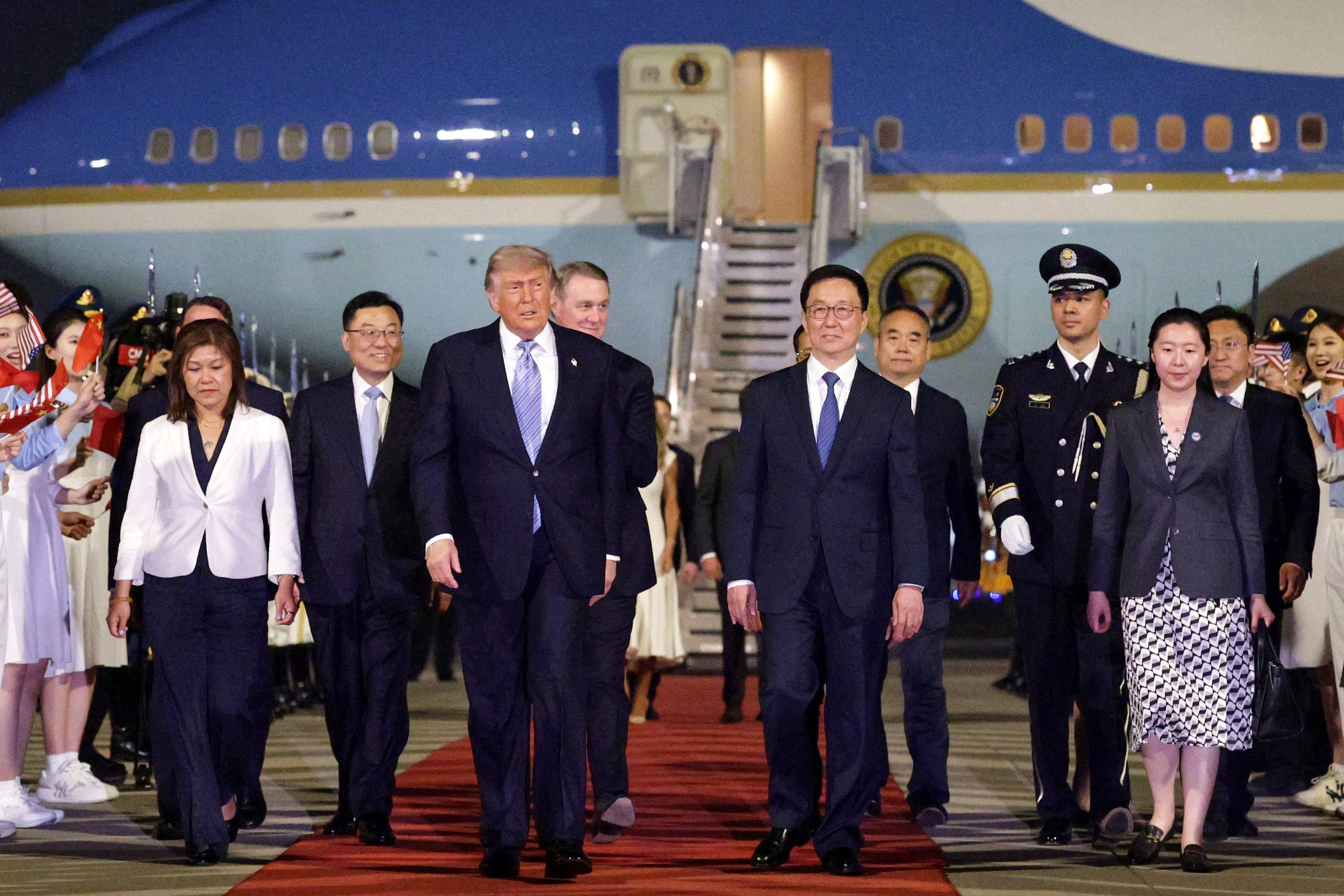
U.S. President Donald Trump has concluded his visit to Beijing for a high-stakes summit with Chinese President Xi Jinping. On the agenda were trade, Taiwan, the Iran War, and AI — but what did the two leaders actually discuss and agree on? ASPI experts unpack summit outcomes in this issue of Asia ASAP.
Where are the Trade Deliverables?
by Wendy Cutler
Thus far, the economic deliverables coming out of the Trump-Xi meeting are way below expectations. Beijing announced the resumption of export permits to U.S. beef producers, a long overdue move. Trump told the press that Xi had committed to purchase 200 airplanes, but Beijing has yet to confirm. The business concerns of Citibank, one of the company CEOs accompanying Trump, were apparently addressed as well.
But what we were led to expect and haven’t seen thus far is not only Chinese confirmation of the U.S. jet purchases, but other Chinese mega-purchases as well, particularly in the agricultural and energy sectors. USTR Greer has indicated that we will see more on purchases, particulary agriculture, beyond soybeans where China has already made a multi-year commitment. Also absent was the announcement of the establishment of a Board of Trade to deal with trade matters and flows in non-sensitive sectors. It’s possible that the two sides are still hammering out the details of the functions and responsibilities of this group, along with the leads in both governments. One area this group is focusing is on lowering tariffs for a basket of goods in the $30 billion range, but that also was not officially shared. A new Board of Investment was also not agreed upon, which would discuss possible new Chinese investments in the United States in non-strategic sectors.
Finally, while both sides welcomed stabilization in the relationship, they did not announce an extension of the trade truce which locks in for one year lower tariff rates, Chinese shipments of critical minerals and magnets, among other things. This truce expires in five months, leaving more time to deal with the nature and duration of any extension.
All of these possible deliverables may still be in the works, so we may see further announcements in the coming days. If further economic outcome announcements are not forthcoming, it’s fair to conclude that this summit meeting was heavy on atmospherics but light on substance, putting more pressure on the two leaders in their upcoming engagements this year to produce meaningful and concerete deliverables.
Xi Delivers Warnings on Taiwan and Stops Short of Committing to Help With Iran
by Lyle Morris
Going into the summit, one of the biggest questions was what President Trump and Xi would say about Taiwan and Iran. Based on Trump’s interview with American media aboard Air Force One on his way home, we found out what each leader said, and more importantly, didn’t say, in regards to these two issues.
On Taiwan, Trump revealed an extended, “detailed” discussion with Xi. Xi reportedly voiced China’s concerns about Taiwanese “independence,” U.S. arms sales, and whether the U.S. would militarily intervene in a conflict over Taiwan. On the latter, Trump said that Xi asked him directly whether the U.S. would “defend Taiwan.” On all three points, Trump said he “listened to what Xi said” but did not say one way or another what the U.S. would do. On arms sales, Trump simply said “I’ll be making a determination on that,” adding “I have to speak with the person running Taiwan,” suggesting Taiwanese president William Lai. On defending Taiwan, Trump said “I’m not going to say that…there’s only one person who knows about that: me.” Trump also expressed optimism that both leaders want peace across the Strait, saying “I don’t think there’s a conflict. I think we’ll be fine. He doesn’t want to see a war:” On one hand, it should reassure both Taipei and Washington that Trump did not alter long-standing U.S. policy on Taiwan. On the other, Trump’s suggestion that he would talk to Taiwan’s president about U.S. arms sales would certainly upset Beijing, and by not offering unambiguous support for Taiwan, Trump’s comments might have added fuel to the fire for leaders in Taiwan who question whether the United States would come to the aid of Taiwan in a conflict with China.
On Iran, what was most interesting, and quite frankly, surprising, was what Trump said Xi told him about China’s position on the conflict. Trump said Xi “feels very strongly that they (Iran) can’t have a nuclear weapon. He said that very strongly. And he wants them to open up the Strait.” This is noteworthy because neither Xi nor any Chinese leader has publicly stated opposition to Iran having a nuclear weapon, choosing instead to call for a ceasefire and de-escalation of hostilities. If Xi indeed voiced such opposition directly, this would represent a new Chinese stance on Iran and should greatly please Trump in his efforts to pressure Tehran to abandon its nuclear weapons program. It is also no surprise that Xi expressed a desire to open up the Strait of Hormuz. But it appears Trump did not obtain any firm commitments from Beijing to actively contribute to a military campaign to keep the Strait open for shipping, for example. Notably, Trump said he did not directly ask Xi to intervene in Iran, saying “I don’t need favors.” So it appears Trump expressed an openness to working with China to put collective pressure on Iran to come to the negotiating table without eliciting any firm commitment from Xi.
In totality, what emerges on Iran and Taiwan is the opening of a longer-term discussion between Trump and Xi on two hot-button issues in the U.S.-China relationship. While Trump did not secure any tangible commitments from Beijing on either issue, he also did not cause undue harm to U.S. interests by unwittingly changing long-standing U.S. policy on Taiwan, for example, which was a concern going into the summit.
A “Constructive Relationship of Strategic Stability”
by Lizzi C. Lee
China’s goal for the Trump-Xi summit is straightforward: get U.S.-China relations back onto steadier ground. Beijing wants to turn volatility, escalation, and policy whiplash into something closer to a managed operating system. Its new phrase, “a constructive China-U.S. relationship of strategic stability,” signals that China wants Washington to treat the relationship as a great-power compact — something more durable than a running inventory of disputes over tariffs, fentanyl, export controls, rare earths, overcapacity, and Taiwan.
AI is a good illustration of both the promise and the complications of this framework. A reported U.S.-China “AI best practices protocol,” alongside possible expanded chip access such as H200, would certainly not end the technology rivalry once and for all. But it does suggest that even in one of the most contentious areas of U.S.-China competition, both sides may be looking for narrow lanes where risk can be managed.
For Beijing, an AI safety protocol serves its own strategic interests. Mythos has sharpened Chinese concerns[1] that frontier agentic AI is moving from abstract risk to real cyber threat. The anxiety is primarily that advanced U.S. models could be weaponized in cyber operations, especially when Chinese firms are excluded from access. So for China, AI safety is not just symbolic language. There is real urgency on containing escalation risks in a domain where technical competition could quickly become a security crisis.
Chip access, however, cuts both ways for Beijing. Chinese firms want Nvidia hardware because it can relieve near-term compute constraints. But China’s security establishment worries that renewed purchases could deepen dependence on U.S. technology — one reason earlier U.S. approval did not quickly translate into deliveries inside China. Beijing may welcome the leverage and short-term relief while slow-walking implementation to protect its longer-term push for indigenous alternatives.
That tension captures the heart of China’s AI strategy after the summit. Beijing wants enough access to keep its firms competitive today, enough safeguards to reduce crisis risk, and enough distance from U.S. technology to preserve its long-term self-reliance agenda. These remain frameworks for now. I will be watching whether both sides can build follow-up mechanisms, test cases, and implementation channels that can survive the election cycles.
For Beijing, the direction is clear: stabilize the U.S. relationship where possible, compartmentalize conflict where necessary, and buy time for China’s economy, firms, and technology ecosystem to operate on less hostile terrain.
[1] Chinese media described the model as showing “unprecedented cyberattack capabilities,” while Chinese experts have warned that AI-enabled attacks could target telecoms, internet infrastructure, supply chains, and older operational technology systems.
Asia’s Cautious Relief
by Shay Wester and Robert Snedden
Official reactions from Asian countries to the Trump-Xi summit have so far been sparse and measured. The early regional response is cautious relief, not reassurance. Asia welcomes stabilization in U.S.-China relations. For Asian governments, a steadier U.S.-China relationship matters because instability can quickly spill into regional security and economic interests. South Korean President Lee Jae Myung captured this before the meeting, saying stable Sino-U.S. ties would support regional stability and global prosperity. Former Australian Prime Minister Scott Morrison wrote after the summit that the meeting “did not reset the world,” but afforded “stability in a sea of uncertainty.”
Still, Asian capitals will judge the summit less by atmospherics than by follow-through. In a nod to an important U.S. ally, President Trump called Prime Minister Sanae Takaichi from Air Force One after leaving China. According to Takaichi, the leaders discussed economic and security issues, suggesting Tokyo seeks a clearer understanding not only on Taiwan and military deterrence, but also on technology controls, supply chains, critical inputs, and industrial competition.
Southeast Asian countries have immediate and practical concerns. Singapore Prime Minister Lawrence Wong’s recent warnings on the Strait of Hormuz capture concern that disruptions to sea lanes, energy flows, and critical supplies are direct economic risks. Governments will assess whether U.S.-China engagement helps keep trade routes open and supply chains functioning, while watching whether potential U.S. tariff relief for China erodes investment advantages that have helped draw firms toward their countries.
Regional leaders will also watch for signs of a “G2” dynamic emerging, with Washington and Beijing managing regional issues bilaterally while others absorb the consequences. For now, they are likely to welcome stabilization, avoid choosing sides, and hedge against the possibility that today’s tactical pause becomes tomorrow’s renewed volatility.