


By Juliet Lee
Editor’s Introduction: Hi there. In today’s issue of Asia Policy Brief, ASPI’s Director of Strategy and Engagement Juliet Lee highlights the successes of middle power participation and sideline engagement at this weekend’s G20 Summit, and a win for multilateralism despite protests from the Trump administration.
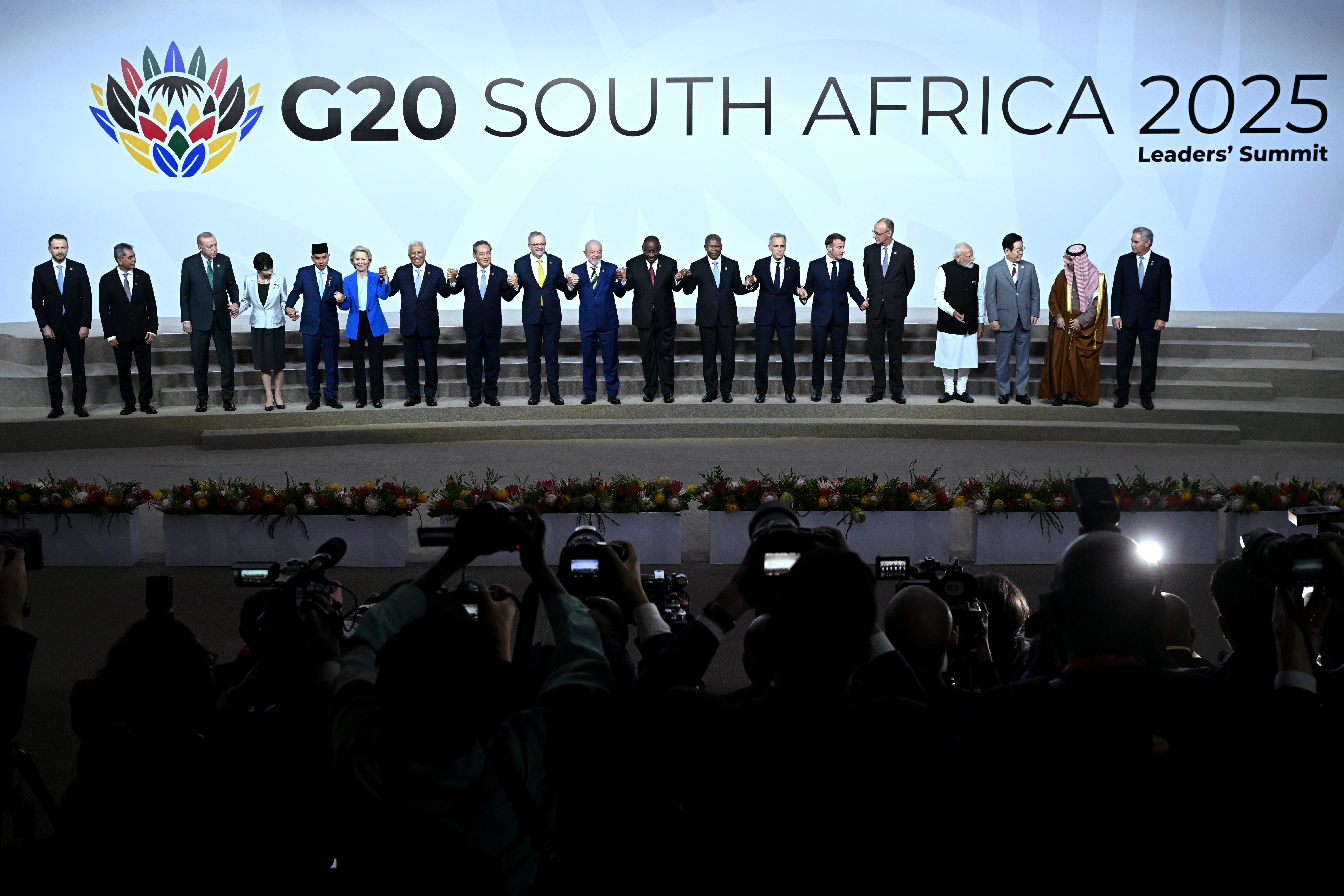
(Photo by Leon Neal/Getty Images)
State of Affairs: The U.S.’ Noisy Absence
This year’s G20 marked the first time an African nation has hosted the multilateral convening, yet the leadup to this historic gathering was overshadowed President Donald Trump’s shifting and inflammatory statements about the host country, South Africa. After erroneously accusing the South African government of seizing white-owned land and allowing the killing of white Afrikaners, Trump announced the U.S. was boycotting the summit. Shortly ahead of this weekend’s convening, Trump further fanned the flames by discouraging member countries from accepting a leaders’ declaration, traditionally issued at the end of the sessions. Nevertheless, South Africa’s President Cyril Ramaphosa broke with tradition by beginning the two-day meeting with the adoption of a 122-point declaration, stating that there was unanimous agreement among almost all of the members present (with one objection from the foreign minister of Argentina).
The absence of a senior U.S. official at the summit drew awkward questions about how South Africa would handle the ceremonial handover to next year’s host, the United States. Shortly before the start of the summit, the Trump administration made a last minute request that the acting U.S. Ambassador to South Africa, with the ranking of charge d’affaires, participate in the ceremony on behalf of Washington, which was declined by President Ramaphosa, who refused to “hand over to a junior diplomat.”
Why It Matters: Asia’s Middle Powers Carry On
Despite the Trump administration’s efforts to oppose the Summit’s agenda under South Africa’s leadership, especially the sections that were focused on climate change, the host country succeeded in securing a Leaders’ Declaration that was signed by some of the world’s richest and top emerging economies. The Declaration called for more attention to issues that particularly affect developing nations, including climate change, rising levels of debt and unfair borrowing conditions, and the green energy transition. The unanimity on display despite U.S.’ attempts to undermine the gathering highlighted the enduring strength and convening power of multilateral institutions, often characterized as ineffective because of their inability to build consensus, and middle power diplomacy in the face of ongoing geostrategic competition.
While the United States boycotted the summit, the other participating countries sought to advocate on behalf of developing nations while striking new deals with each other in a flurry of sideline diplomacy. The “middle powers” of the G20 grouping—particularly countries of Asia such as India, Indonesia, Japan, and South Korea—saw the opportunity to take on a larger, more influential role at the meetings. In the U.S.’ absence, many of these countries sought arrangements that allow them to balance engagement with both Washington and Beijing on issues spanning from security and trade to emerging technologies and critical minerals.
Further evidence of a push towards multilateral cooperation by Asian middle powers is the flurry of bilateral and trilateral agreements that came out of sideline engagements in Johannesburg. One of the most notable accomplishments was Modi’s bilateral with Canada’s PM Mark Carney, during which the two countries agreed to restart trade negotiations that would more than double bilateral trade through a Comprehensive Economic Partnership Agreement. This thaw in India-Canada relations comes after a diplomatic row that saw the removal of the countries’ top diplomats from each other’s capital, perhaps a sign that the two countries are seeking alternative paths forward as their respective relationships with Washington stall over ongoing trade and political tensions. Furthermore, Modi, Carney, and Australia’s PM Anthony Albanese also announced a new Australia-Canada-India Technology and Innovation (ACITI) Partnership that would deepen collaboration between partners across three continents and three oceans on emerging technologies, diversification of supply chains, clean energy, and adoption of AI.
The proposed G20 initiatives, particularly those from Modi, were in direct response to global challenges such as strengthening healthcare systems, upskilling workers along with the mass adoption of AI, and responding to climate-related disasters. Indonesian VP Gibran Rakabuming Raka stressed that all countries are entitled to determine their own designs and strategies for advancing development, and that no country has the right to impose its views on development upon others because “there is no one-size-fits-all model” for global cooperation. While the U.S. may not have participated, this year’s G20 Summit is evidence that the global order continues to spin without it.
What to Watch: Whither Unilateralism?
G20 in 2026: U.S. officials have already claimed that the G20 under U.S. leadership will look very different: “We have whittled down the G20 back to basics,” according to U.S. Treasury Secretary Scott Bessent. After four consecutive Global South presidencies, how will a U.S. administration with an “America First” agenda bring together countries representing 85% of the world’s GDP and more than 75% of global trade? Who will be invited, and perhaps more importantly, who else might boycott in 2026, following the U.S.’ example this year?
Don’t Forget China: China’s Premier Li Qiang, who led the Chinese delegation to this year’s G20, echoed Xi Jinping’s call for unity in tackling global economic challenges, warning against rising unilateralism, protectionism, and growing trade restrictions. China is set to host next year’s Asia-Pacific Economic Cooperation (APEC) Forum, another multilateral convening that President Trump skipped attending earlier this month. How will Beijing exert its influence and fill the gap as Washington continues to retreat from multilateralism? How will middle powers respond as many continue to pursue and implement trade agreements beyond relying on the U.S. and China?
Is the Momentum Sustainable? Global interdependence, while presenting distinct advantages for developed countries, has not resulted in equitable benefits for emerging and developing economies. As the U.S. continues to wield unilateral, punitive actions, many countries around the world are seemingly seeking alternatives and rallying together on behalf of the global good. Following the successes of the G20, as well as the COP30 Summit in Belém where the Trump administration was also a no-show, can the multilateral momentum led by middle powers by sustained?
Dive Deeper with ASPI:
Join ASPI in Washington, D.C. on December 16 for an in-person panel discussion on “Risks and Opportunities for the U.S.-Japan Alliance.”
Read a recent Australian Financial Review op-ed by Taylah Bland on how “COP30 Escaped Echo Chamber Despite Trump No-Show.”
Watch a recent panel discussion on “After Gyeongju: APEC 2025 Outcomes and the Future of Regional Cooperation,” moderated by Wendy Cutler.
Read ASPI’s report, “Cementing the Quad in the Indo-Pacific,” written by Farwa Aamer and Emma Chanlett-Avery.