


By Farwa Aamer
Editor’s Introduction: Hi there. In this week’s Asia Policy Brief, ASPI’s Director for South Asia Initiatives Farwa Aamer highlights India’s diversification strategy through New Delhi’s engagements with Indo-Pacific countries and beyond on trade, energy, regional security architecture, and technology.
(Photo by Asanka Ratnayake/Getty Images)
State of Affairs: Expanding Room for Strategic Maneuver
India’s strategic environment is becoming harder to navigate amid a fragmented global order and exacerbating risks associated with economic interdependence, disrupted supply chains, and the fallout from regional conflicts. New Delhi’s response thus far has not been about choosing sides. Instead, it has focused on expanding its room for maneuver. By cultivating multiple partners and sources of supply, India is seeking to reduce the risks of dependence on any single entity or geography while advancing its economic, geostrategic, and technological interests.
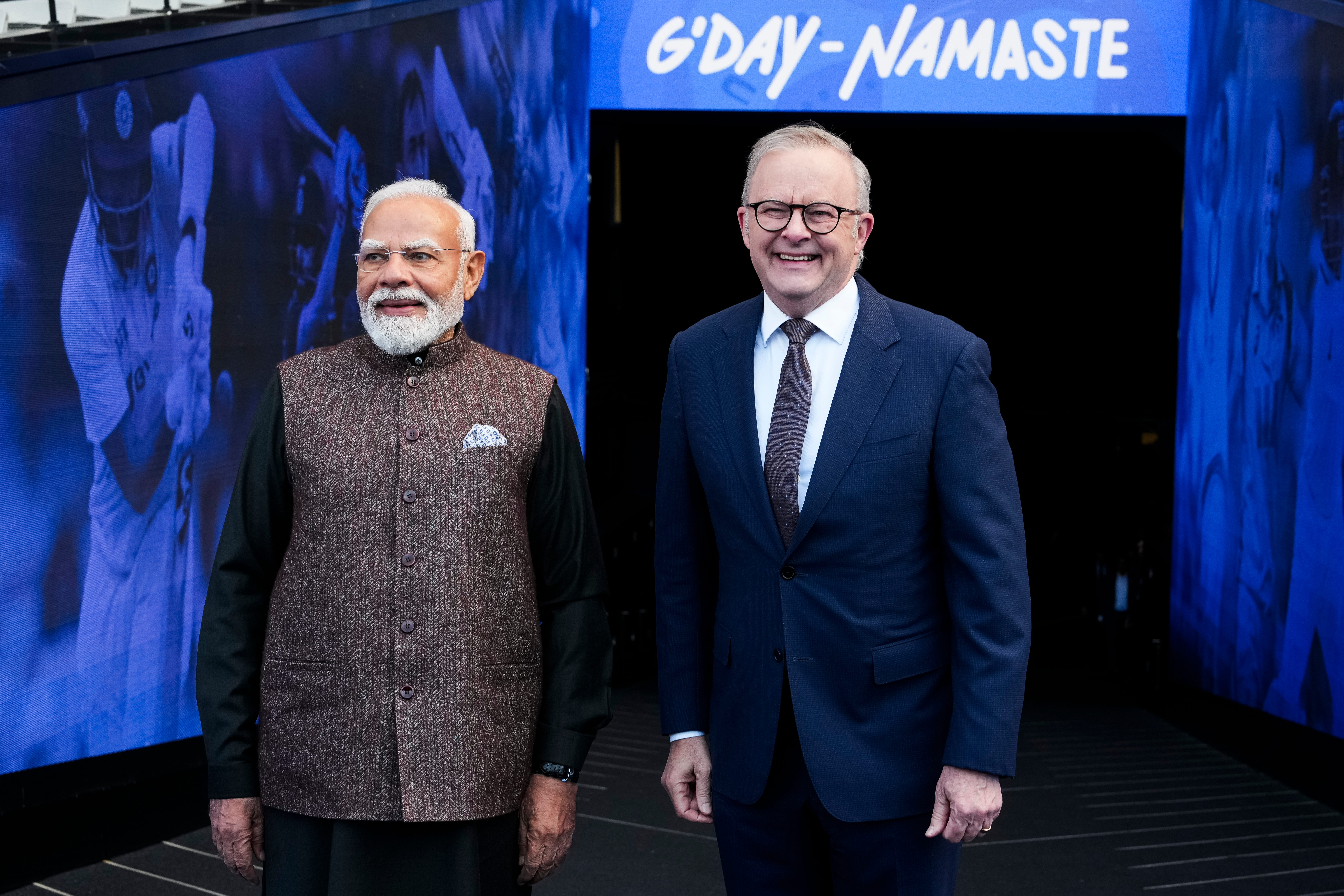
This logic was particularly visible last month. Japanese Prime Minister Sanae Takaichi’s visit to New Delhi reaffirmed the importance of one of India’s most consequential Indo-Pacific partnerships. India and Japan have been proactively advancing cooperation on AI, defense, and economic security, recognizing the importance of leveraging their mutual complementarities. Prime Minister Narendra Modi’s subsequent three-nation visit to Indonesia, Australia, and New Zealand further underscored India’s effort to build a wider regional network spanning defense, energy, critical minerals, trade, and connectivity.
While the Indo-Pacific has stood out, India’s diversification is global in nature. New Delhi is simultaneously strengthening relationships with Europe, Canada, and the Gulf as uncertainty in U.S. economic and foreign policy and renewed instability in the Persian Gulf complicate the external environment. India is building a sufficiently broad portfolio of partnerships to absorb shocks, pursue national interests, and negotiate from a position of greater flexibility.
Why It Matters: The Need to Overcome Costly Structural Dependencies
The United States remains India’s most consequential strategic partner, yet the past year has also highlighted the limits of assuming that strategic convergence guarantees policy predictability. Shifts in U.S. trade and foreign policy have introduced greater uncertainty into the relationship, even as Washington continues to see India as an important Indo-Pacific partner. Meanwhile, China’s growing economic influence and strong foothold in India’s neighborhood presents a continued challenge. Although India and China have taken steps since 2024 to stabilize relations, engagement remains largely cautious and shaped by deep strategic mistrust and territorial disputes. China has also overtaken the United States as India’s largest trading partner, but with a trade balance heavily tilted in Beijing’s favor.
For New Delhi, the question is therefore not whether to choose Washington over Beijing, or vice versa, it is how to overcome costly structural dependencies. This gives India’s longstanding practice of multi-alignment a more practical purpose in reducing concentration risk while preserving strategic flexibility.
Trade offers a clear example. The finalization of the India-UK FTA, the conclusion of India-EU FTA negotiations as the “mother of all deals,” and advancing Comprehensive Economic Partnership Agreement talks with Canada, among other economic partnerships in Asia, are efforts to help create alternatives at a time when U.S. trade policy has become less reliable, even as trade negotiations on an interim deal with the United States remain ongoing. For India, the more diversified its export base, the better positioned it will be to absorb disruption in any one market and serve its long-term economic growth prospects.
Energy makes the case even more stark. The ongoing conflict in the Persian Gulf has once again exposed vulnerabilities in global energy and commodity supply chains, and the implications for import-dependent economies like India whose heavy dependence on energy supplies, especially those routed through the disrupted Strait of Hormuz, leaves it particularly exposed. India has therefore diversified its energy sourcing across the United States, Venezuela, and Russia, even as U.S. pressure and the weight of retaliatory tariffs have previously led India to rethink its oil import infrastructure and ultimately reduce its reliance on Russian energy. Looking to the long term, as geopolitical disruptions and fresh U.S. pressures continue to pose risks to Indian energy interests, expanding strategic petroleum reserves, diversifying suppliers, and widening cooperation with partners such as Japan and the UAE are all logical initiatives. Australian uranium exports, agreed upon during Modi’s recent visit, are also meaningful for India’s civil nuclear ambitions as the country aims to install nearly 100 gigawatts of nuclear power by 2047.
Regional security architecture is also changing rapidly, with countries casting a wider net of defense partnerships. India’s defense diplomacy is reflective of this trend and is evolving along similar lines. The BrahMos deals with the Philippines, Indonesia, and Vietnam illustrate the strategic value of this approach. Defense exports can strengthen India’s domestic industrial base and boost economic interests while creating durable security relationships in Southeast Asia, a region central to its Act East policy and vision for a secure and stable Indo-Pacific.
The global technology race has also made diversification even more consequential. Semiconductors, AI, critical minerals, and advanced manufacturing are increasingly sources of geopolitical leverage. India aims to develop sovereign AI capabilities, but a more realistic strategy is to develop critical capabilities at home while connecting to multiple trusted sources of capital, technology, expertise, and supply. Partnerships with Japan and France on AI, and with the Dutch ASML on semiconductor capabilities, reflect this approach.
None of these efforts are to disengage from either Washington or Beijing. India continues to deepen cooperation with the United States and is invested in improving bilateral economic and technology ties. It has joined the U.S.-led Pax Silica and continues to remain active in the Quad. At the same time, India is maintaining channels with China through continued bilateral engagements, as seen in the recent meeting between External Affairs Minister S. Jaishankar and Foreign Minister Wang Yi on the sidelines of the ASEAN foreign ministers’ meeting last month. President Xi Jinping may visit India for the BRICS summit in September and Modi and Xi may also meet earlier on the Shanghai Cooperation Organization (SCO) sidelines as the two sides seek to gradually repair ties making border stability a priority.
What to Watch:
How the Pakistan-Türkiye-Saudi Arabia defense agreement reshapes India’s Gulf calculus: New Delhi will need to assess what the emerging security alignment means for its own interests. It will also be worth watching whether India responds by leaning further into its strategic relationships with the UAE and Israel as a way of preserving regional economic and security interests.
India’s Central Asia push: Prime Minister Modi is expected to visit Kyrgyzstan (for the SCO summit) and Uzbekistan next month, bringing India’s Central Asia outreach into sharper focus. The timing also matters as the SCO is meeting amid significant regional and global turbulence, while Central Asia itself is becoming an increasingly consequential strategic space, making a stronger case for India to develop durable economic and strategic linkages with the region.
What a U.S.-China thaw or a sharper confrontation means for India’s hedge: U.S. policy toward China has remained mixed under Trump 2.0, and President Trump’s expected meeting with President Xi next month could provide an indication of whether the relationship is moving toward greater confrontation, managed competition, or some form of accommodation. In the case that Washington and Beijing increasingly shape the rules of the international system between themselves, how much room will middle powers have to hedge, and how will India respond?
Dive Deeper with ASPI:
Dive into the latest news and insights from South Asia each month with Farwa Aamer by subscribing to South Asia Snapshot.
In an episode of Asia Inside Out, Akshay Mathur speaks with Ambassador Gurjit Singh about the future of India’s relationship with ASEAN.
In a recent article for ASPI, Arun Teja Polcumpally highlights why India’s semiconductor ecosystem needs Taiwan’s SMEs to build a deep tech corridor.
Good analysis of India’s position and strategy. India had invented non-alignment and continues to be master of that statecraft. In the increasing unipolar world today that is the best strategy as all countries act based on their national interest at the end of the day, multiple partnerships focused on India’s key interest is the way to go