


By Emma Chanlett-Avery and Juliet Lee
Editor’s Introduction: Hi there. In today’s Asia Policy Brief, Emma Chanlett-Avery, Director for Political-Security Affairs, and Juliet Lee, Director of Strategy and Engagement, highlight Korean President Lee Jae Myung’s visit to San Francisco and Brazil, and how the outcomes of this week’s trip demonstrate South Korea’s unique position as both an indispensable partner in the global development of AI and emerging Asian middle power.
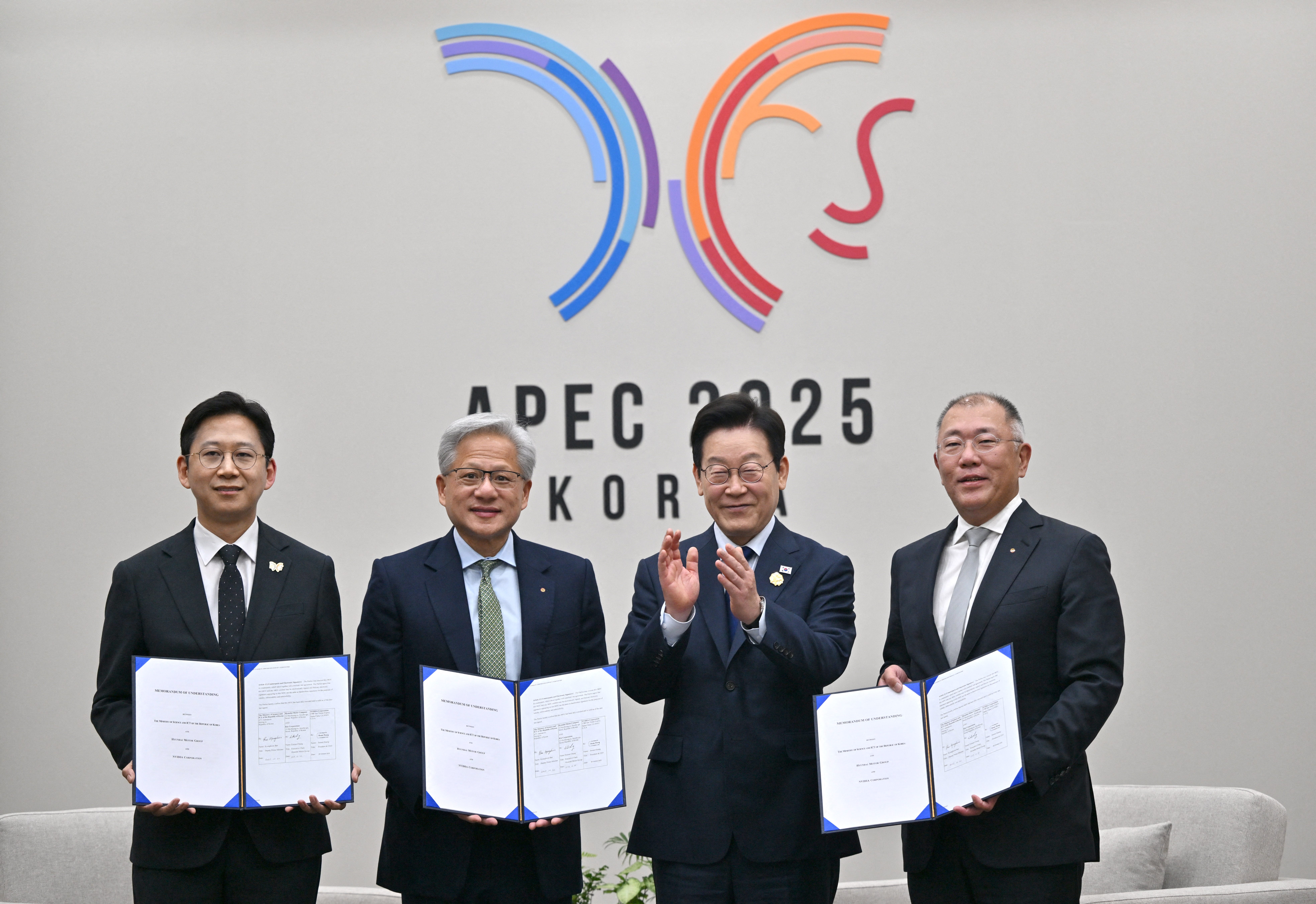
(Photo by JUNG YEON-JE/POOL/AFP via Getty Images)
State of Affairs: Lee Jae Myung in Silicon Valley
On the first stop of an 11-day tour of the United States and South America, South Korean President Lee Jae Myung hosted an AI summit in San Francisco that brought together top South Korean business figures—including Samsung Electronics’ Lee Jae-yong, SK Group’s Chey Tae-won, Hyundai Motor’s Group Euisun Chung, and Naver’s Lee Hae-jin—with leading AI developers such as Nvidia’s Jensen Huang, Open AI’s Sam Altman, Anthropic’s Dario Amodei, and Broadcom’s Hock Tan. The high-stakes convening of key figures in the global AI ecosystem demonstrated South Korea’s role as a key driver in the AI revolution, as Seoul leverages the country’s industrial comparative advantage and governance expertise to propel its AI industry onto the global stage.
At the summit, President Lee introduced the “San Francisco AI Declaration,” unveiling his vision for South Korea to become “a core nation in the global AI supply chain” and pave the way for partnerships with global technology companies in a new era of AI. To that end, South Korea announced $950 billion in new AI initiatives, including a $500 billion deal between Nvidia and SK Hynix spanning large-scale AI data centers and next-generation memory. Prior to the summit, Samsung Executive Chairman Lee, Hyundai Executive Chair Chung, and Nvidia CEO Huang were appointed to the Global Advisory Board for Silicon Valley & the World.
After the San Francisco summit, President Lee traveled to Brazil, where he is concluding a four-day state visit, including Lee’s fifth meeting overall with Brazilian President Lula da Silva. Lee highlighted the need to strengthen South Korea’s diplomacy with the Global South “at a time when the international order is being rapidly reshaped.” This trip falls shortly after Lee attended the NATO Summit in Ankara, where he proposed deepening South Korea’s ties with NATO by focusing on cutting edge technologies, including AI, in the military partnership.
Why It Matters: A Tech Giant Among Middle Powers
South Korea is in a unique position to leverage its status as both a global tech superpower and an emerging Asian middle power that can serve as a critical link between the Global South and Global North.
According to Stanford University’s Global AI Vibrancy Tool, South Korea is among the leading countries—with the United States, China, and India—in the development and production of AI technology, providing ripe opportunities for expanded alliance and regional cooperation in the rapidly developing field. The Korean government is also at the forefront of establishing a more coherent institutional architecture—Seoul enacted its Framework Act on the Development of Artificial Intelligence and Establishment of Trust, the world’s second, in January 2025, less than a year after the EU AI Act was entered into force in August 2024. Following this legislation, the Korean government established an AI Action Plan, outlining 99 action items and 326 policy recommendations, with the stated goal of becoming one of the world’s top three AI powers. South Korea has emerged as indispensable to the global AI ecosystem, strengthening areas where it has distinct advantages, such as high bandwidth memory (HBM) chips—Samsung and SK Hynix control roughly 90% of the global HBM supply—and growing AI infrastructure investment.
Since AI development is concentrated primarily in the United States and China, middle powers continue to face mounting pressure to align with one ecosystem or the other. However, as an advanced industrial middle power with a critical position within the global technology supply chain, South Korea has long navigated asymmetric relationships by aligning with Washington on security issues while maintaining essential economic ties with Beijing. South Korea is uniquely positioned to serve as a critical bridge between major and middle powers. It has formed robust relationships with Japan, India, Australia, and India among others through strategic partnerships and trade agreements, while its experience of rising from its war-torn, poverty-stricken history to become an economic and technological powerhouse serves as a powerful example for developing economies.
In an effort to hedge against an unpredictable Trump administration, the Lee administration continues to intensify its diplomatic diversification efforts, maintaining steady alliance relations with the United States while seeking to reduce overdependence by broadening South Korea’s autonomy. In 2026 thus far, President Lee has visited China, Japan, Singapore, the Philippines, India, and Vietnam; and he has hosted leaders from Italy, Brazil, Ghana, Indonesia, France, and other countries in Seoul. At this year’s G7 Summit in France, where the “safe and beneficial deployment” of AI featured prominently on the agenda, President Lee stressed the importance of inclusive growth through technology and innovation, as well as stable supply chains, in the AI era.
What to Watch: The ROK’s “Pragmatic Foreign Policy”
The G7: Seoul’s ambition to transition from frequent guest to permanent member of the G7 has garnered significant support. South Korea’s economic and military power, along with its advanced technology sector, make it a strong candidate. Challenges remain: South Korea must be willing to broaden its priorities beyond the Peninsula, accept the obligations that come with being considered a major power, and, critically, continue to reinforce the partnership with Japan, as the path to membership in the G7 likely runs through Tokyo.
The Global South: South Korea has pursued engagement with the Global South by emphasizing solidarity and its experience of transitioning from an aid recipient to an aid provider. It has focused on efforts in supply chain resilience, climate change mitigation, and public health. Given its strength in developing and deploying AI, South Korea’s could facilitate AI adoption in developing countries. The majority of Seoul’s efforts focus on India and Southeast Asia, but it has also engaged with other BRICS countries, particularly Brazil. By straddling these two worlds, South Korea could become a significant contributor to bridging different countries.
The Alliance: President Lee has pursued a pragmatic foreign policy by maintaining a strong U.S.-ROK alliance while also diversifying Seoul’s diplomatic options. President Trump’s transactional approach to alliances and erratic foreign policy, including the war with Iran that has significantly disrupted South Korea’s energy markets, could depress cooperation on sensitive technologies in the military sphere. Given these challenges, can the flourishing of commercial AI partnerships with the private sector propel alliance cooperation on technology, innovation, and startups?
Dive Deeper with ASPI:
Emma Chanlett-Avery and Farwa Aamer highlight for Nikkei Asia how the summit between Takaichi and Modi underscored growing ties between Tokyo and New Delhi, and how the two countries must harness middle-power momentum.
Check out a new episode of Asia Inside Out, where Farwa Aamer speaks with Anirudh Suri about India’s evolving AI strategy, its pursuit of technological sovereignty, and how, as a middle power, it can collaborate with like-minded partners to advance shared AI goals.
In a recent report, “Designing Metrics to Enable Trusted AI Ecosystems in Asia,” Arun Teja Polcumpally and Faye Simanjuntak propose a framework of nine key metrics to build trust in AI across Asia, highlighting how gaps in trust, not just technology, are slowing adoption and shaping uneven progress. The report offers policymakers a practical roadmap to measure, compare, and strengthen AI ecosystems across Asia.