


By Farwa Aamer
Hi there. In today’s Asia Policy Brief, ASPI’s Director of South Asia Initiatives Farwa Aamer highlights Secretary Rubio’s trip this week to Mumbai and Jamnagar and prospects for progress in U.S.-India bilateral relations, particularly on energy trade and commercial engagement.
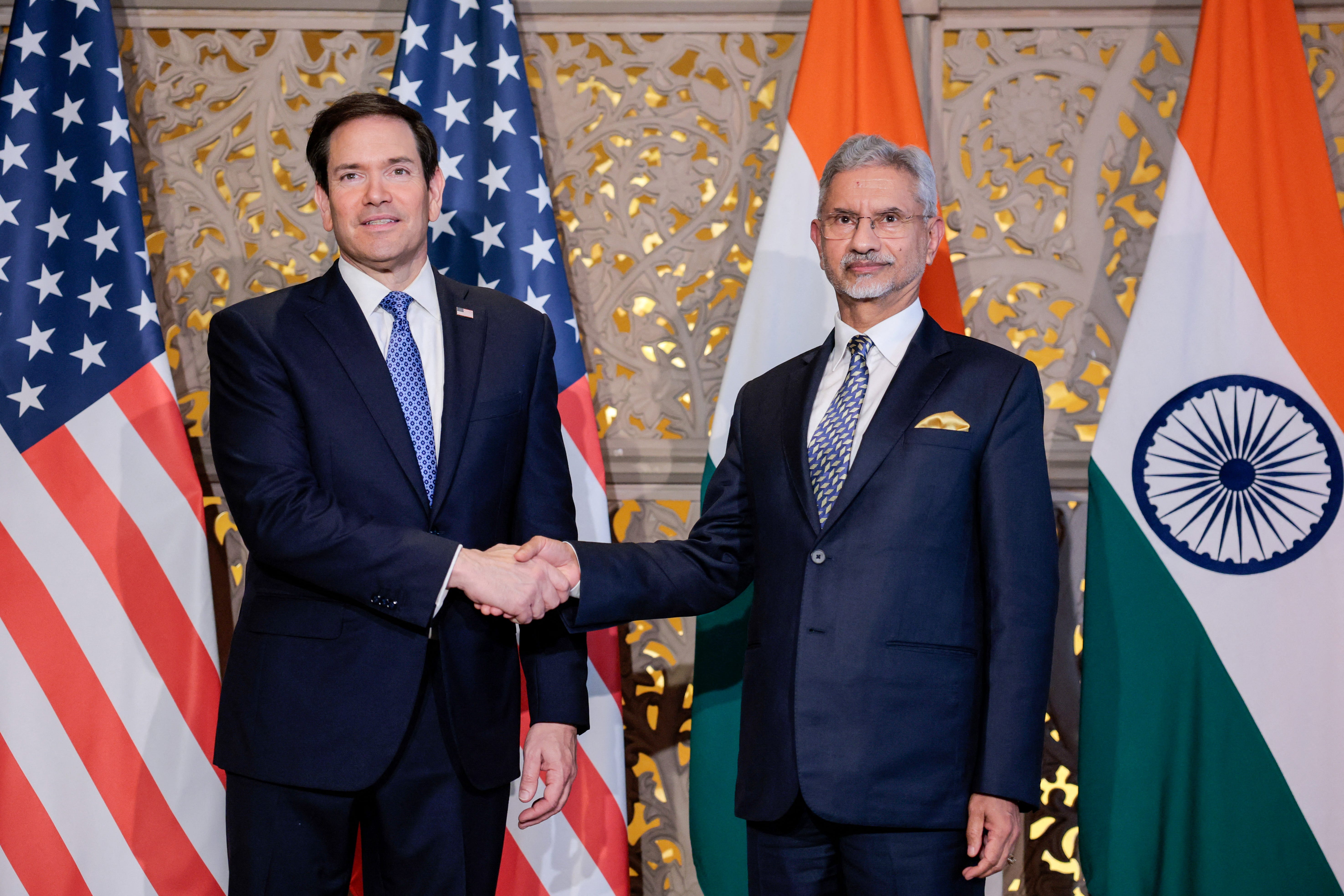
(Photo by Kylie Cooper / POOL / AFP via Getty Images)
State of Affairs: Rubio Chose Mumbai for His Second Official Visit to India This Year
U.S. Secretary of State Marco Rubio’s second visit to India this year came with an unusual itinerary. Rather than making New Delhi his first stop this week, Rubio headed to Mumbai and Jamnagar, placing India’s financial capital and one of its most consequential energy hubs at the center of his trip.
Arriving directly from Uzbekistan, Rubio came to India at a delicate moment in the bilateral relationship. Trade negotiations, according to India’s finance minister, had reached a plateau. The threat of sanctions under the Lindsey O. Graham Sanctioning Russia and Iran Act of 2026 had added another layer of uncertainty before President Trump granted a 60-day waiver to assess the economic implications. Meanwhile, Washington’s immigration policy had created fresh concerns for India’s technology sector, with major Indian IT companies facing new restrictions on access to U.S. green cards.
Rubio’s visit this week had both a diplomatic angle to help strained bilateral ties as well as a focused economic and energy aspect to advance cooperation in areas where the relationship could still deliver tangible results.
In Mumbai, Rubio met India’s External Affairs Minister S. Jaishankar, to discuss regional and global developments, including energy trade. He also participated in a U.S.–India–UAE trilateral foreign ministers’ meeting, aimed at deepening economic integration between the three countries and advancing cooperation on artificial intelligence, trade, and investment.
At a Freedom 250 reception in Mumbai, Rubio celebrated the significance of U.S.-India ties while acknowledging that the partnership would not be free of disagreements. His assessment of the broader South Asia region was certainly revealing, as he stated that “the 21st century will be defined, for better and for worse, by what happens in this region.”
But the business meetings arguably offered the clearest indication of where Washington wants the relationship with India to go next. Rubio met representatives of some of India’s most influential corporate groups, including Adani Group’s Gautam Adani, Reliance Industries’ Mukesh Ambani, and Tata Sons’ N. Chandrasekaran.
Rubio’s private sector engagement is reflective of the reality of modern-day international relations where governments are no longer the only stakeholders in foreign policy. Especially for the United States, the trajectory of its bilateral relations, including with India, will largely depend on what American businesses and partner countries are willing to build and invest in together.
Why It Matters: The Energy Calculation Ahead of Key Midterm Elections
Rubio’s decision to prioritize Mumbai over New Delhi attracted considerable attention. But from the perspective of the Trump administration’s commercially driven foreign policy, the choice was hardly surprising. Mumbai is the financial center of an economy Washington wants to engage more deeply, and its corporate leadership has become progressively significant to the U.S.-India relationship. Leadership diplomacy is important, but building a broad-based cooperation anchored in long-term economic pillars including energy and technology can help relationships bounce back from individual political disagreements.
As the ongoing conflict between the United States and Iran puts pressure on global energy markets, the cost and availability of oil and refined products have become increasingly sensitive issues for Washington, raising the political stakes ahead of midterm elections.
Diesel prices reportedly reached $6.53 per gallon in September, and such high fuel prices have become a source of voter backlash. This domestic imperative has contributed to Washington’s more pragmatic approach to energy supplies, including its recent sanctions waivers and the Russia diesel deal, marking a departure from the harder line it had initially taken on Russian oil over the Ukraine war. The same imperative helps explain Rubio’s interest in engaging India, the “refining superpower.”
When Rubio met Jaishankar on October 21, before heading to Jamnagar in Indian State of Gujarat, he reiterated the importance of increased energy trade in helping diversify India’s supply chains. Reliance Industries and its Jamnagar refining complex occupy a particularly important place in that effort and the evolving U.S.-India energy relationship. Reliance is already investing in a new Texas oil refinery announced earlier this year and is among the largest buyers of Venezuelan crude. As more Venezuelan oil comes onto the market, Washington has an incentive to encourage Reliance to take on additional supplies, potentially easing some of the pressure on global energy markets.
The broader question is whether this commercial and energy convergence can help unlock progress elsewhere in the relationship. If bilateral energy trade and commercial activity expand, and provided the threat of a further 100% tariff over India’s Russian oil imports does not resurface, there may be greater room to move the trade negotiations toward conclusion. The tariff threat has been a major source of friction between the two countries. Although both sides have repeatedly pointed to progress in the negotiations, talks have continued to stall at key sticking points. Rubio, however, struck a notably confident tone during his visit, saying that a deal was “something we anticipate seeing in a matter of weeks, not months.”
Whether that optimism translates into an agreement remains to be seen. The underlying hope is that greater commercial engagement could give both sides a practical incentive to contain their differences, even if it does not all out resolve them.
Another platform that brings India and the United States together on energy is the Quad. The grouping launched the Quad Initiative on Indo-Pacific Energy Security in May and committed to cooperation across the entire energy value chain. Rubio also sought to reaffirm Washington’s commitment to the Quad during the visit, underscoring the importance of a free and secure Indo-Pacific to both the United States and India. He raised the prospect of a leaders’ summit on the sidelines of the ASEAN Summit, when the four countries’ leaders gather in Manila next month.
What to Watch: Broader U.S.-India Ties
1. The Quad’s next test: political commitment?
Will a Quad leaders’ summit take place this year, and, if it does, how much political weight will the four countries attach to it? A summit would provide an opportunity to restore greater momentum and may help fast-track action on recent initiatives including on energy cooperation.
2. Future of U.S.-India energy cooperation and the trade deal
It will be important to see what a measure of success for both sides in terms of greater energy cooperation would be and the timeline for it given ongoing global energy pressures. There is also a link to how India’s increased purchases of U.S. energy could help address bilateral trade woes. Rubio’s confidence that a trade deal is weeks away signals optimism, but the history of negotiations counsels caution.
3. How will the evolution of U.S. foreign policy reshape India’s strategic value?
This may be the most consequential question beyond the immediate visit. A U.S.-Russia rapprochement could reduce the pressure on India over its purchases of Russian oil, but it could also complicate New Delhi’s efforts to deepen its relationships with European partners in trade, defense, and technology. Europe’s approach to Russia, and its own strategic priorities, may not align with Washington’s policy pivots.
The same uncertainty applies to U.S. policy toward China. If Washington moves toward a G2-style framework in which the two powers manage their competition, India’s value as a counterweight to China could diminish in Washington’s strategic calculations. But that outcome is not inevitable. If energy, trade, and technology become more prominent pillars of the U.S.-India relationship, India’s importance to Washington could rest on a broader, sturdier foundation than its role in balancing Beijing.
Dive Deeper with ASPI:
Read Farwa Aamer’s recent article, “South Asia’s Critical Minerals Moment: India, Pakistan, and U.S. Diversification Efforts.”
Watch a recent ASPI panel, “The Quad Reassessed: Regional Dynamics and the Indo-Pacific Strategic Future,” featuring Ken Jimbo, Thitinan Pongsudhirak, Zack Cooper, and Farwa Aamer. Emma Chanlett-Avery moderates the discussion.
Read an ASPI Delhi roundtable summary by Arun Teja Polcumpally on “AI Sovereignty and Global Interdependence: Navigating Industry Realities.”