


By Rishi Gupta
Hi there. In this week’s Asia Policy Brief, ASPI Delhi’s Assistant Director, Dr. Rishi Gupta, analyzes the shifting foreign policies of Bangladesh and Nepal, which elected new governments and leaders earlier this year with stronger mandates for change on their domestic and foreign policies, and their respective engagements with India and China.
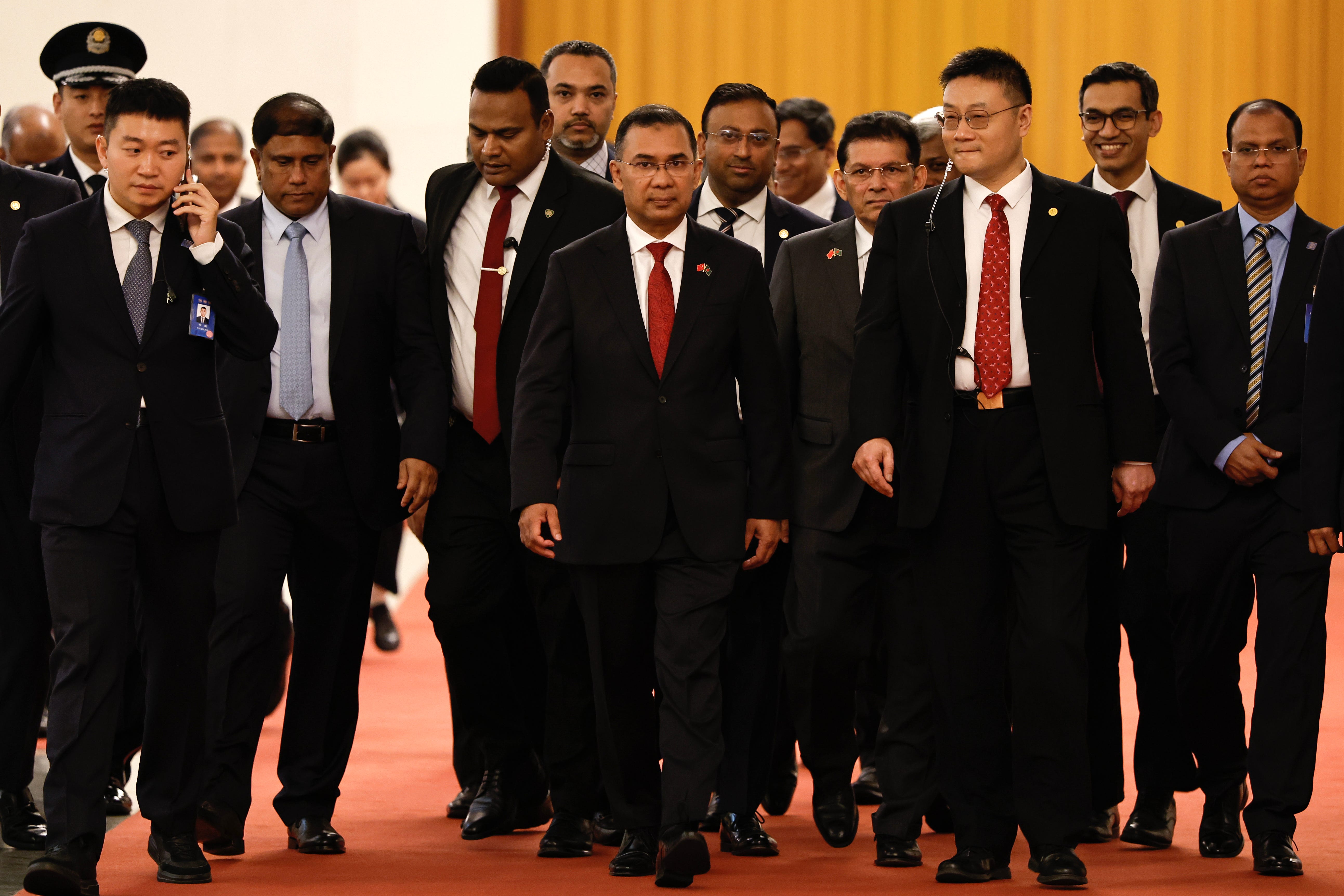
(Photo by Tingshu Wang-China Pool/Getty Images)
State of Affairs: New Leadership and Foreign Policy Priorities in Dhaka and Kathmandu
On August 5, Bangladesh’s former Prime Minister Sheikh Hasina appeared at an online, audio-only press conference in Delhi. The presser marked two years since her escape from Bangladesh in 2024 after a violent movement, popularly known as the “July Uprising.” Dhaka was outraged at Hasina’s online appearance and termed it “detrimental to the development of harmonious bilateral relations between Bangladesh and India.” By demanding her extradition and strongly objecting to her presence in Delhi, Dhaka seems to be making Hasina’s extradition a condition for normalization of bilateral ties.
Despite Dhaka’s conditions, Delhi has been making diplomatic efforts. In a rare move to strengthen outreach with Dhaka earlier this year, Delhi appointed Dinesh Trivedi—a former minister and currently a senior West Bengal politician from the ruling Bharatiya Janata Party (BJP)—as India’s new High Commissioner to Bangladesh. Delhi also elevated Trivedi to the rank of a cabinet minister, underscoring the political importance India attaches to diplomatic engagement with Bangladesh. However, worsening Delhi-Dhaka relations are considered a key factor in Prime Minister Tarique Rahman’s decision to break from the tradition of visiting India for his first foreign visit as head of state and instead taking a two-nation tour of Malaysia and China in June.
Similarly, Nepal’s relations with India have sparked an uproar in the Pratinidhi Sabha (the lower house of parliament). On August 18, opposition parties demanded that Prime Minister Balendra Shah—the country’s youngest elected leader and a popular political figure among the youth since Nepal’s Gen Z Movement—be present in parliament to face questions over controversial remarks he made about the boundary dispute with India. At a time when bilateral negotiations are ongoing to resolve the border dispute with India, Prime Minister Shah’s remarks caused domestic criticism, forcing the foreign ministry to clarify that the Prime Minister’s statement “should be understood in the context of this technical reality and the issue of cross-border occupation,” but the damage was done.
Why It Matters: South Asia’s Pivot Away from Delhi?
With Bangladesh and Nepal having undergone domestic transitions following historic Gen Z movements that overthrew established parties and leaderships, the two countries’ new leaderships are shifting their foreign policies by diversifying partnerships, including with China, and reducing India’s traditional primacy in their external relations. This is raising concerns for India—a country that has long held regional centrality.
The rise of Balendra Shah in Nepal and Tarique Rahman in Bangladesh concerns Delhi on two key fronts. First, the politicization of foreign policy issues, such as bilateral relations with India, in Bangladesh and Nepal could mean that public opinion increasingly influences the governments’ decision-making. This could constrain pragmatic engagement with Delhi, especially given that Hasina’s presence in India and ongoing border issues with India are portrayed domestically in both countries as compromising national sovereignty or autonomy. Though political developments such as the Gen Z movement present an opportunity for India to support countries like Bangladesh and Nepal in their rebuilding and development, such transitions also mean new leaders may not necessarily carry the “burden of history” in engaging with India.
Second, for India, the question is: will China become the new actor in Bangladesh and Nepal, and further in South Asia? Delhi’s diplomatic impasse with Kathmandu and Dhaka is not limited to these two capitals, as a political undercurrent criticizing India persists regionally. Social media movements like #IndiaOut in the Maldives and #BackOffIndia in Nepal create space for actors like China to exploit these sentiments to its benefit by presenting Beijing as an alternative economic and strategic partner. For China, South Asia is a critical geography, providing access to the Bay of Bengal, the Indian Ocean, and the Arabian Sea, as well as a major trade market. Furthermore, Beijing’s potential defense cooperation with countries like Bangladesh, which has reported interest in buying China’s J-10 fighter jets, and joint army training exercises with Nepal push Delhi to observe these regional developments closely.
At the same time, new leadership in Nepal and Bangladesh presents China an opportunity. In the past five years alone, Beijing’s projection as a new mediator between Pakistan and Afghanistan, or Pakistan and Bangladesh, indicates that China’s diplomatic outreach is more consequential than ever. It also signals China’s growing ability to shape regional equations, agendas, and convenings by isolating India and positioning itself as an alternative broker in a region traditionally seen as Delhi’s sphere of influence.
What to Watch:
Prime Minister Rahman’s visit to India on hold: On August 10, India’s High Commissioner in Dhaka Dinesh Trivedi met the Bangladesh Prime Minister, during which Dhaka raised concerns about Sheikh Hasina’s extradition and her movements in India. Trivedi’s next-day trip to Delhi to meet Prime Minister Narendra Modi signaled the urgency India attaches to Rahman’s potential visit. While Prime Minister Modi assures an “honorable reception” to Rahman, the question remains whether Bangladesh would overlook Delhi’s demand for Hasina’s extradition and normalize ties to continue engaging with India. However, Prime Minister Rahman reportedly has no immediate plans to visit India anytime soon, especially when Dhaka conveys “no justification for rushing into a top-level visit by going beyond the national interest.”
Dhaka’s indication to join the Mecca pact: The much-talked “Mecca Joint Defense Agreement“ between Saudi Arabia, Türkiye, and Pakistan is referred to as a regional “Islamic” security pact, where “any armed attack against any one of the three States shall be regarded as an attack against them all.” Given tensions between India and Pakistan, the pact is being closely watched in Delhi. However, discussions that Bangladesh may also join, as indicated by Prime Minister Rahman’s advisor, Humayun Kabir, raise alarm in India.
Prime Minister Shah’s first state visit since taking office: Prime Minister Shah had indicated he will make no foreign visits his first 100 days in office, citing domestic issues as a key priority for his government. While there is still no clarity after his 100-plus days in office, when he does decide, the choice of destination—India or China, two key neighbors—would have significant implications for India’s broader Himalayan security. While a visit to China could mean Beijing’s diplomatic success and a deeper strategic presence in Nepal, a trip to Delhi would certainly reassure India of the historical “special relationship” and the success of border-related negotiations in resolving differences. Meanwhile, since Nepal’s new government took office in March 2026, India has intensified high-level engagement at both the government and political levels, including a grand welcome to Nepal’s ruling party’s Chairman in June, followed by Nepal’s Foreign Minister Shisir Khanal’s visit to Delhi in the same month. This August, Indian Army Chief General Dhiraj Seth visited Nepal for an official event, meeting Prime Minister Shah and President RC Paudel.
Dive Deeper with ASPI:
Join ASPI for a virtual panel discussion on “Asia’s Digital Alignment Through Trade,” featuring Elina Noor and Nigel Cory in conversation with Faye Simanjuntak.
Watch a recent ASPI webinar, “Bangladesh and Nepal After Political Transition: New Leadership, New Directions” featuring Anil Giri, Raheed Ejaz, and Rishi Gupta. Farwa Aamer moderates the discussion.
Follow ASPI’s The Ballot Box: Why Elections Matter for Asia for timely updates, in-depth insights, and expert analysis on elections and political transitions across Asia.
Don't know much about Bangladesh but Nepal can never shift away from India. The country practically has no alternative to India. The currency's pegged, about 2/3rd of trade (both imports and exports) is with India. Yes, the new government is seen as pro-West, but geographical realities cannot be overcome by political leaning. Nepal is like Bhutan for India, but with an enhanced political voice and anti-India nationalism. But at the end of the day, it's still within Indian Sphere of Influence.
India's outreach to both Nepal ,Bangladesh , Srilanka and Bhutan needs to restrategise especially with cultural, social and economic cooperation . Geopolitics can come later. India's priority now seems muddled. It seems to be more interested in revitalizing its cooperation with far off nations in Europe and West Asia ,trying to be an actor in global politics, even as its issues with the immediate neighbours hang fire. This seems to be a flawed approach.