


By Farwa Aamer and Emma Chanlett-Avery
Editor’s note: Following unsuccessful peace talks between the U.S. and Iran in Islamabad, Farwa Aamer, Director of South Asia Initiatives, and Emma Chanlett-Avery, Director of Political-Security Affairs, explain how the conflict in the Middle East has dragged Asia’s middle powers into the fray—and how they are reacting.
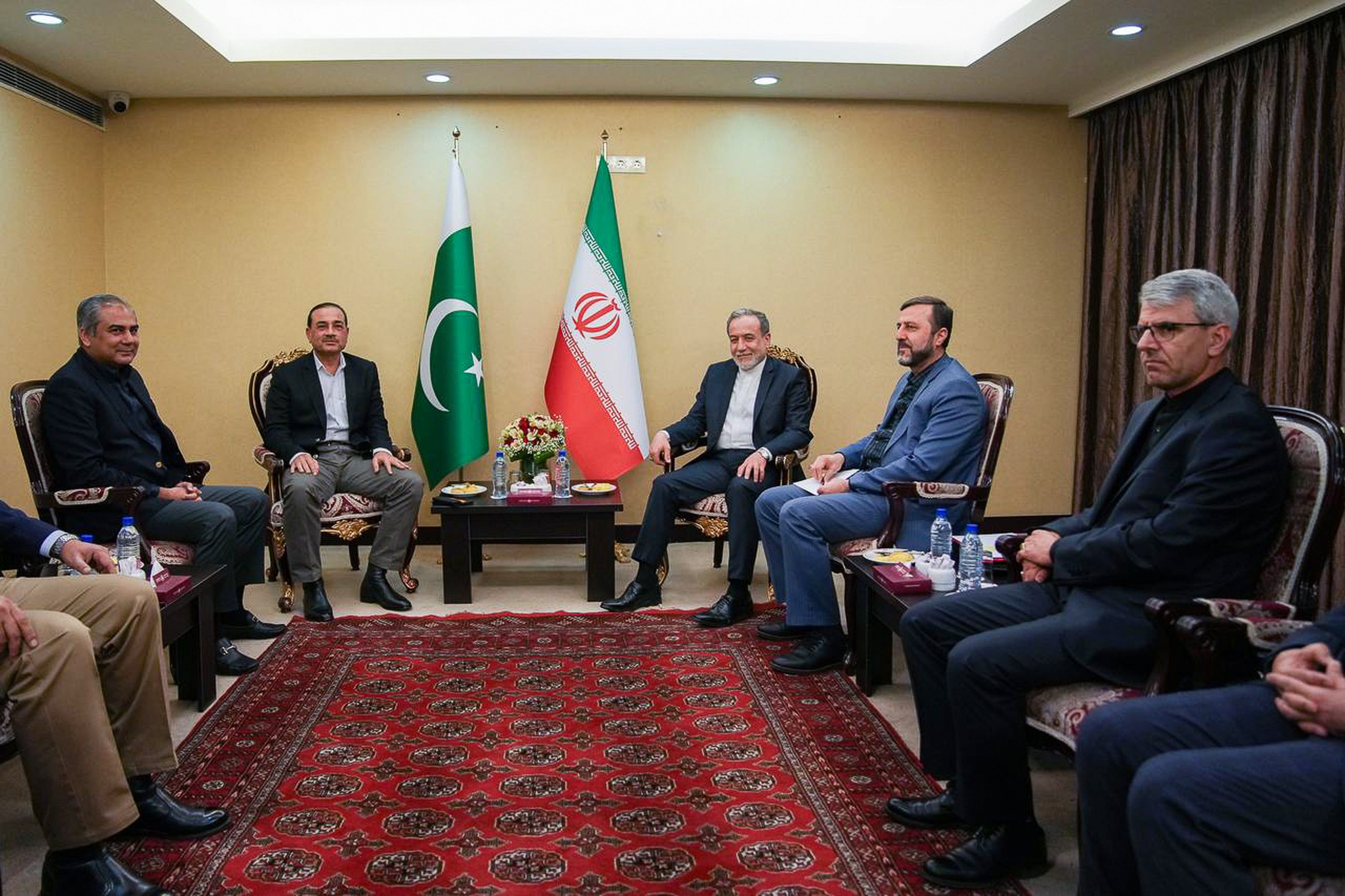
(Photo by Iranian Ministry of Foreign Affairs/Handout via Getty Images)
State of Affairs: Pakistan Pushes for Peace
As the U.S.-Israel-Iran conflict escalated over the past weeks, the fallout reverberated around the world, exposing vulnerabilities and further fragmenting traditional alliances. Great power politics continued unabated, with the war introducing new dynamics: the much-anticipated Xi-Trump summit was postponed and the agenda re-shaped; the disruption to energy supplies and oil price volatility became a boon to energy exporting Russia and reduced attention to Ukraine; and U.S. military assets streamed from the Indo-Pacific theater to the Middle East. For middle powers, these shifts are defining. The conflict underscores a deepening rupture in the global order, compelling these countries to navigate an environment marked by both heightened urgency and profound uncertainty.
Amid this turbulence, an unexpected actor emerged: Pakistan. Leveraging its relationships with both United States and Iran, as well as broader regional ties, Islamabad positioned itself as a pivotal intermediary. Its mediation efforts culminated in a two-week truce announced on April 7. Although the subsequent “Islamabad Talks” failed to produce a durable agreement, there is speculation that U.S. and Iranian teams could return to Pakistan for another round of talks as early as the end of this week. For now, the ceasefire remains intact, even as Israeli strikes on Lebanon and the U.S.’ blockade of the Strait of Hormuz continue to test its limits.
Why It Matters: Crisis, Realignment, and Diplomatic Openings
President Trump’s war of choice imposed devastating consequences for the global economy with deep ramifications for Asia, which remains heavily dependent on Gulf energy flows through the Strait of Hormuz. In response, regional governments have introduced emergency measures to stabilize supply and manage price volatility. While these steps may blunt immediate disruptions, they also reveal deeper structural vulnerabilities tied to energy dependence and geopolitical chokepoints. More broadly, the crisis underscores the need for middle powers to work in concert to mitigate the impacts of a war many label as illegal under international law.
For these countries, the conflict is a stress test of both strategic doctrine and economic resilience. As the global order splinters, the space for hedging is narrowing and the costs of ambiguity are rising. Existing institutions, such as the Group of Seven, the United Nations Security Council, and the International Energy Agency, provided rapid coordination, including strategic oil reserve releases by key economies. These efforts demonstrate both the continued relevance of institutional frameworks and their limitations under sustained geopolitical strain, highlighted by the failure of the Quad to coordinate a response and mounting pressure on BRICS as the group remains divided over Iran.
Another consequence that middle powers may confront is the need to turn to China and Russia, the alternative hegemons in the region. If governments decide to invest more heavily in renewable energy to lessen dependence on Middle East oil and gas, China dominates the green energy technology sector with wind, solar, and battery products. Russia offers its own significant oil and gas reserves for export. The Iran crisis could stymy middle power efforts to avoid reliance on China and Russia, at the expense of U.S. influence.
National responses illustrate both adaptation and constraint. Japan emerged as a first mover in the international reaction to the war. In addition to the decision to release strategic petroleum reserves, Prime Minister Sanae Takaichi was the first foreign leader to meet with President Trump after hostilities began in the Middle East. Despite President Trump’s calls for allies to provide military assistance in the conflict, Takaichi successfully rebuffed his demands. Given Japan’s image as generally malleable to Trump’s pressure, this refusal provided a model for other allies—particularly NATO—to similarly decline offering assistance.
Within the Indo-Pacific, India’s response highlights the constraints of multi-alignment. With significant stakes in its relationships with both Israel and Iran, and the added strain of chairing BRICS at a critical moment, New Delhi has adopted a cautious, neutral stance. While this approach has somewhat helped insulate domestic economic interests, it also emphasizes the difficulty of reconciling competing strategic commitments in an increasingly polarized environment.
Meanwhile, middle power diplomacy has accelerated markedly. In 2026, Japan and South Korea have held in-person leaders’ level summits with Canada, Indonesia, the Philippines, Italy, and France. Main agenda items were supply chain resilience for critical minerals, defense industrial cooperation, and—as the U.S.-Israel war on Iran began—coordinating on global energy market stabilization. In his meetings, French President Macron advanced the need for countries to distance themselves from major powers and forge another path ahead together. As Canadian Prime Minister Carney addressed Australia’s Parliament, he called on Canberra to forge new alliances, saying “Canada and Australia cannot compel like the great powers, but we can convene, set the agenda, shape the rules, and organize and build capacity through coalitions to deliver results at speed and global scale.” While European and Canadian leaders more explicitly promoted a coordinated middle power strategy, Indo-Pacific partners such as Japan and Australia have emphasized diversification rather than outright distancing from great powers.
Taken together, these developments point to a deeper transformation in middle power diplomacy. Pakistan’s role in the crisis is illustrative not because it is anomalous, but because it reveals an emerging pathway for middle power influence. By positioning itself as a central intermediary while simultaneously coordinating with regional actors such as Saudi Arabia, Turkey, and Egypt, Pakistan operationalized networked agency. Its leverage did not derive from material dominance, but from its ability to connect, align, and mobilize a web of relationships that no single great power could fully replicate in that moment.
What to Watch
The durability of the ceasefire—and the trajectory beyond the initial two-week horizon—will shape whether Asian and European governments move toward more assertive strategies to secure alternative energy supplies, either collectively or unilaterally. At stake is not only short-term market stability, but whether middle powers can translate crisis coordination into more durable mechanisms for managing energy security and geopolitical risk. In this sense, the conflict is a test of whether middle powers can coalesce into a functional bloc capable of stabilizing both markets and regional order. Critically, will these countries bypass antiquated global institutions that resist reform and instead shift toward more informal, national interest-driven coordination?
The crisis may also accelerate the formation of new, more fluid security arrangements in response to gaps in U.S. security guarantees. The growing coordination among regional actors, particularly Saudi Arabia, Turkey, Egypt, and Pakistan, suggests the early contours of a more decentralized security architecture. It will be important to see how these countries institutionalize their cooperation for not only Middle Eastern stability but also the strategic options available to Asian middle powers navigating the region.
Finally, observers should track whether the depth and breadth of the conflict drive countries toward other centers of power, particularly if the United States withdraws precipitously. Russia’s energy empire (already gaining from sanction waivers) could offer lifelines to starved economies, while China’s dominant renewable energy sector may provide building blocks for those governments rattled by their dangerous dependence on Middle East resources.
Dive Deeper With ASPI
Read Farwa Aamer and Emma Chanlett-Avery’s report unpacking the broader state of middle power diplomacy amidst the fragmenting global order.
Register for ASPI’s April 21 webinar assessing the forces driving hedging behavior, middle power partnerships worth watching, how effectively countries are exercising agency collectively, and what a more assertive middle power landscape means for the U.S.
As the U.S. and China prepare for President Trump’s May visit to Beijing, check out Bryanna Entwistle’s op-ed arguing that anti-scam cooperation should be on the agenda.