


Editors Note: In this week’s edition of Asia Policy Brief, Kristina Lozinskaya, Schwarzman Fellow at ASPI, provides a read out of Russian President Vladamir Putin’s visit to Beijing from May 19-20, 2026. She explains where the China-Russia relationship remains resiliant and where cracks have emerged in this supposedly “no limits” partnership.
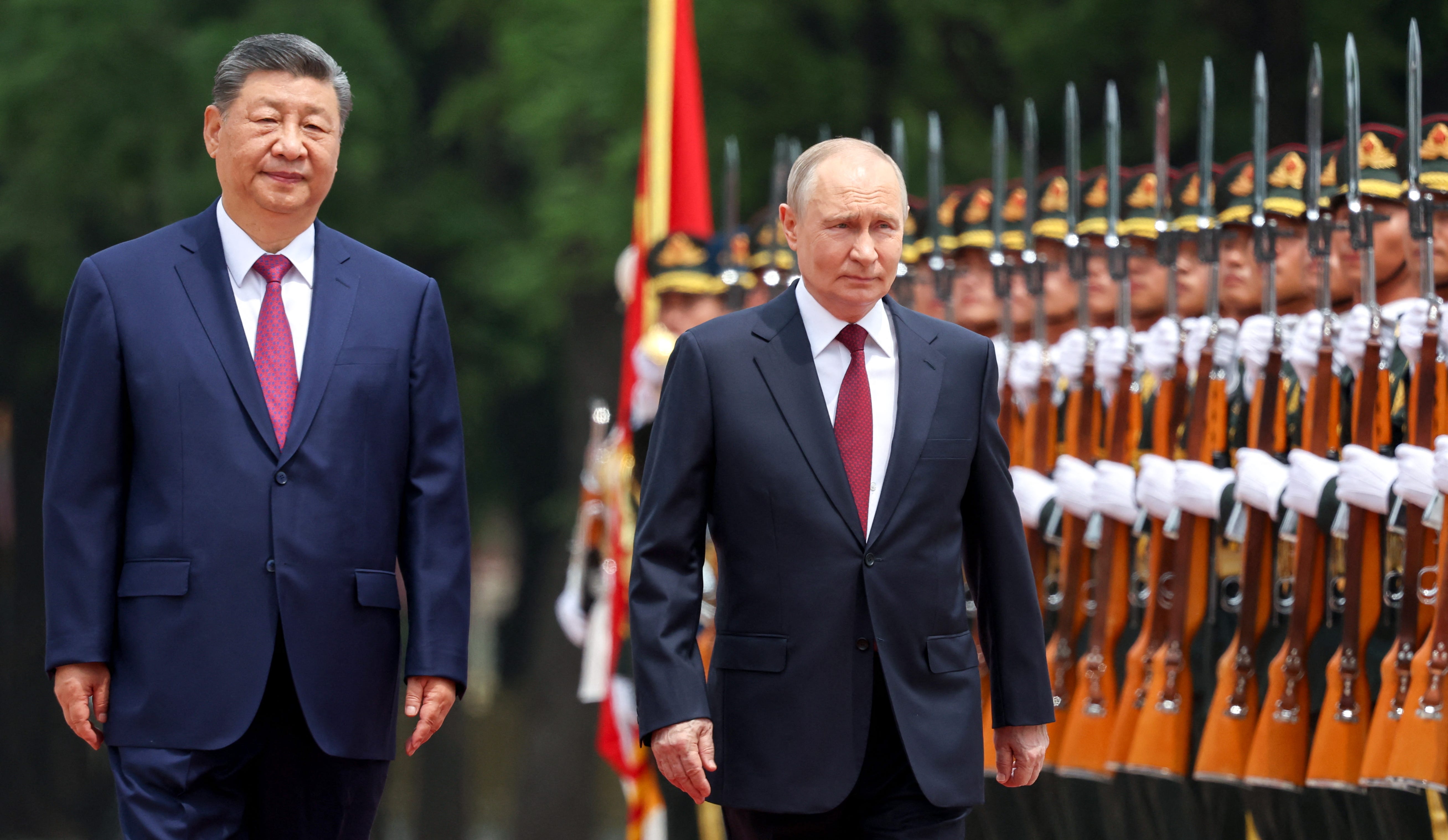
(Photo by Alexander KAZAKOV / POOL / AFP via Getty Images)
State of Affairs: Xi Hosts Putin Four Days after Trump
Four days after Chinese President Xi Jinping held a high stakes summit with U.S. President Donald Trump, Beijing welcomed President Putin with comparable grandeur. Commemorating the 30th anniversary of the “China-Russia Strategic Partnership of Coordination,” Xi praised their strategic cooperation as reaching a “historic high,” while Putin hailed the two as a stabilizing force in the world. The leaders signed around 40 agreements focused on the economy, trade, education, science, and technology.
In an indirect jab at Washington, the two leaders issued a joint statement warning of the unprecedented damage caused by unilateralism and hegemony and cautioned against regressing to the “law of the jungle.” Alluding to the U.S. seizure of Venezuelan President Nicolás Maduro earlier this year, both sides condemned “treacherous military strikes against other countries…the provocation of regime change, and the brazen kidnapping of national leaders for trial.” They criticized the U.S. and Israel’s ongoing war against Iran as a violation of international law, called the United States “irresponsible” for allowing the New START nuclear treaty to expire, and condemned Trump’s proposed Golden Dome missile defense system as a threat to global stability.
Why It Matters: Silence Speaks Volumes
The visit marked Putin’s 25th to China, during which he sought to project a united front and showcase Moscow’s continued importance to Beijing. In some sense, Putin succeeded: the nearly 10,000-word joint statement and a flurry of documents that emerged from the meeting were a stark contrast to the few solid outcomes that have emerged thus far from the Trump-Xi summit.
However, while Xi touted political mutual trust as the “hallmark” of Sino-Russian relations, it was the silence on two key issues that revealed where trust may be faltering. Putin notably failed to secure Xi’s sign off on the Power of Siberia 2, a 2,600km pipeline that would double Russia’s natural gas exports to China. Moscow and Beijing signed an MOU on the pipeline in September of 2025, but discussions over pricing, financing, and contract conditions have stalled the start of construction. Putin initially sought a quick deal to help mitigate the effects of being cut off from the European energy market after his invasion of Ukraine, but it now looks like negotiations could take years. Even as Beijing faces energy security pressures from the fallout of the Iran War, Xi doesn’t appear to be in a rush, instead showing a reluctance to deepen its long-term dependence on Russian gas.
The two partners sought eachother’s support on their most contentious territorial issues, yet they diverged in their enthusiasm. On Taiwan, Moscow reaffirmed its firm support for the One China policy. On Ukraine, Beijing said that it continues to favor a diplomatic solution to the conflict but stopped short of expressing support for Russia’s offensive. In fact, shortly before Putin landed in Beijing, the Financial Times reported on a conversation in which Xi told Trump that Putin might regret his 2022 invasion of Ukraine, though the Chinese foreign ministry promptly refuted the report and called it “fabricated.” Xi’s rumored remark is a far cry from the sentiments expressed in the joint statement issued after Putin and Xi’s meeting, which mentions Russia’s positive assessment of China’s “objective and impartial position on issues related to the situation in Ukraine.” Although the Chinese side did not elaborate on what exactly that position is, Moscow would have surely welcomed stronger rhetorical support from Beijing in the wake of an increase in the latest Ukrainian drone incursions inside Russia.
Beijing’s hesitance on the Power of Siberia 2 pipeline and restrained position on Ukraine highlight an apparent unwillingness, at least on the Chinese side, to increase mutual dependence, casting doubt on Xi’s vaunted political trust in Putin even as both sides claim the relationship is at a “historic high.”
What to Watch
Shangri-La Dialogue: Though it does not send a delegation to the annual security summit, Moscow will be watching what Beijing has to say later this week at the Shangri-La Dialogue in Singapore. At previous dialogues, Beijing has deflected accusations of material support to Russia’s war in Ukraine, though it has provided indirect support for the Russian war effort with dual-use goods exports, technology transfer, and purchases of discounted oil and gas in defiance of sanctions. Given mounting curiosity over Xi’s rumored criticism of Putin’s offensive, it will be interesting to see whether the Chinese delegation attempts to clarify Beijing’s stance on Ukraine or makes any broader statements about the China-Russia relationship.
Global Agenda: The joint statement from the Putin-Xi Summit covered every imaginable aspect of cooperation and is significantly more comprehensive than the version signed in 2021 at the 20th anniversary of the singing of the “China-Russia Treaty of Good Neighborliness and Friendly Cooperation,” a treaty that laid the foundation for their current partnership. In the joint statement signed last week, China and Russia both pledged to work on uniting the countries of the Global South, outlining their vision for a self-sufficient Africa, independent Latin America, and peaceful Asia-Pacific with ASEAN at the center. Watching where their cooperation will strive to override competition will be telling of the true state of bilateral relations.
Military and AI Cooperation: While denouncing global militarism, Moscow and Beijing vowed to continue “deepening mutual trust in the military sphere, improving cooperation mechanisms, and expanding the practice of joint exercises and air and maritime patrols.” China and Russia also pledged to further deepen cooperation on artificial intelligence, including, alarmingly so, military applications and global governance efforts. After the summit, Moscow announced hopes to power its flagship AI model with Chinese chips, potentially paving way for Russia to depend on China in the most important technology of today, which Putin once said would allow one to rule the world. The automation of warfare, the lack of proper AI guardrails, and the ramping up of Sino-Russian military cooperation are all points of concern to track further.
Dive Deeper With ASPI
Check out the Center for China Analysis’ initiative “Brothers Forever: Unpacking the Conundrum of China-Russia Relations.”
Watch Kevin Rudd, Orville Schell, Wendy Cutler, Danny Russel, Jing Qian, and Lizzi Lee discuss the outcomes of the Trump-Xi Summit and what lies ahead for the bilateral relationship.
Read Pierre Andrieu’s analysis of Beijing’s strategic calculus in the Ukraine conflict and its broader ambition to present itself as a responsible global power.