


By Shay Wester
Editor’s Note: In today’s issue of Asia Policy Brief, Shay Wester, Director of Asian Economic Affairs at Asia Society Policy Institute, examines the ways Southeast Asian economies have moved to diversify since the April 2025 tariff shock and what that pattern suggests about the region’s economic future.
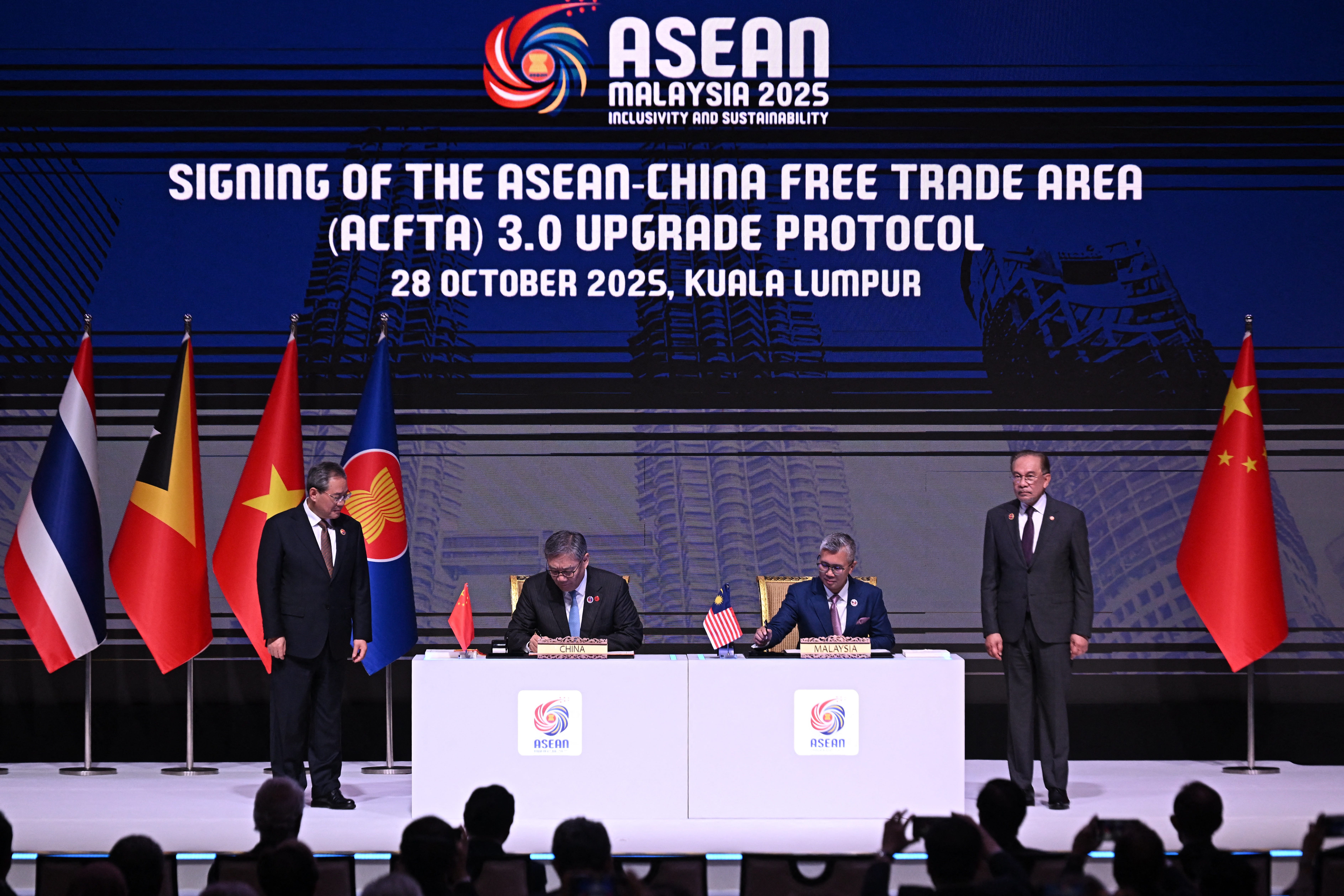
(Photo by LILLIAN SUWANRUMPHA/AFP via Getty Images)
State of Affairs: A Region Building Buffers
While Washington remains focused on using tariffs and bilateral deals to reshape trade ties, Southeast Asian economies have been moving on a different track. Over the past year, they have accelerated efforts to find new markets, upgrade trade agreements, and build buffers against a more volatile global economy. ASPI’s trade team has followed activity spanning new and upgraded free trade agreements (FTAs), digital pacts, supply chain initiatives, and energy and critical minerals partnerships.
This is not just a story of ad hoc national efforts: ASEAN is moving forward with a free trade upgrade with China (ACFTA 3.0), a Digital Economic Framework Agreement (DEFA), and the launch of FTA upgrade talks with Korea. DEFA is especially important because it aims to create a common regional framework for digital trade and data governance. Bilateral efforts are moving alongside these ASEAN-level initatives. Indonesia has made deals with the EU and Canada, Malaysia has signed an FTA with South Korea, and Thailand is pushing for new agreements with the EU and other partners. These are not a scattershot of unrelated deals, but a region-wide attempt to reduce concentration risk.
Trade patterns have shifted along with economic diplomacy. ASEAN’s manufactured exports grew nearly 14 percent in 2025—more than half of which came from markets beyond the United States and China. Vietnam and Cambodia expanded their roles in final assembly of consumer electronics and apparel, while Malaysia and Singapore strengthened their positions in AI-and-semiconductor-linked supply chains.
ASEAN’s ties with China are part of the region’s diversification story, not separate from it. ACFTA 3.0 adds new chapters on digital economy, green economy, and supply-chain connectivity. ASEAN governments are not retreating from China, but rather are broadening links across multiple sectors.
Still, economies with concentrated trade relationships and weak buffers remain exposed to volatility and shocks. President Donald Trump’s “Liberation Day” tariffs brought the risks of relying too heavily on the U.S. market to the forefront, and uncertainty has remained elevated following the Supreme Court’s IEEPA ruling. The Iran conflict has compounded that pressure, exposing fresh vulnerabilities in energy, shipping, fertilizers, and critical industrial inputs. Together, these pressures help explain why diversification has shifted from a long-term aspiration to a more urgent policy priority.
Why It Matters: Southeast Asia Is Building Resilience in Three Ways
What matters is not simply that Southeast Asia is diversifying, it is how and what that says about where the region thinks the global economy is heading. The emerging pattern is not one of retreat from trade, nor of alignment with any single power. It is a broader effort to build resilience through more options, denser partnerships, and less concentration.
Three elements of Southeast Asia’s diversification strategy stand out. First, governments are writing new trade rules. Older agreements are being upgraded and new ones negotiated to cover digital rules, supply chains, critical minerals, investment, and green economy issues. For example, Indonesia has concluded Comprehensive Economic Partnership Agreements (CEPAs) with the EU, Canada, and Peru; reached a trade agreement with the Eurasian Economic Union; and continued pursuing Comprehensive and Progressive Agreement for Trans-Pacific Partnership (CPTPP) accession. Malaysia, Thailand, and the Philippines are pursuing similar tracks with the EU, while Singapore’s role in launching the Future of Investment and Trade (FIT) Partnership of small and mid-sized economies shows ASEAN members also testing new plurilateral formats.
Second, many economies are working to expand markets and suppliers while preserving access to the United States as a major export market and investment partner. Vietnam is a case in point. The U.S. remains its largest export market, but Hanoi is also reducing the risk of future disruption by broadening options almost everywhere else: an FTA with the European Free Trade Association and deeper ties with the EU, Mercosur negotiations, industrial cooperation with India, stronger supply-chain links with China, and major energy agreements with Russia. Other economies are positioning themselves in different ways: Malaysia and Singapore through higher-value roles in semiconductor and AI supply chains, Thailand through a mix of assembly and more advanced manufacturing, and Indonesia through a more commodities driven path.
Third, governments are building resilience in the sectors most likely to become chokepoints. An increasing amount of the activity now underway does not fall in the category of classic trade deals. It includes cooperation on energy, critical minerals, logistics, digital infrastructure, and industrial inputs. The Philippines-Indonesia nickel corridor is one example, as is Indonesia-Japan and Philippines-Canada critical minerals cooperation. Other efforts range from integration of semiconductor supply chains to digital agreements and regional infrastructure coordination.
Together these approaches suggest something more durable than a short-term reaction to tariff hikes. Southeast Asia is not choosing between Washington and Beijing. It is trying to avoid having to choose at all through wider rule-setting partnerships, broader market and supplier options, and practical investments in critical sectors.
What to Watch
Whether Southeast Asia’s recent wave of deals and upgrades actually takes hold. Asian Development Bank analysis finds that the number of agreements negotiated matters less than whether they are deep enough, coherent enough, and implemented well enough to reduce uncertainty in practice. Amid the surge of recently concluded agreements, pending negotiations, and regional upgrades, the critical question is how quickly new rules translate into predictable market access, working customs procedures, aligned standards, and compliance systems that businesses can actually navigate.
Can the 2026 deal pipeline deliver? Southeast Asian governments are planning an unusually ambitious year for trade deals. The Philippines hopes to conclude EU talks by mid-year and to finalize FTAs with Chile and Canada this year. Thailand is targeting parallel conclusions with South Korea, Canada, and EFTA. Malaysia’s EU track is moving toward its next round in June. Not all of these timelines will be met, but those that do will shape how durable the momentum turns out to be.
Whether the region’s diversification push becomes more collective. The Regional Comprehensive Economic Partnership (RCEP) general review scheduled for 2027 will be a test for whether the 15 members use it to deepen rules on digital trade, supply chains, services, and other areas. So will the trajectory of CPTPP in terms of accession bids by Indonesia and the Philippines, updates in certain chapters, and whether cooperation between CPTPP and ASEAN moves from rhetoric to concrete outcomes.
Will the broader resilience agenda take hold beyond trade deals. Some of the most consequential moves underway are not classic market-access agreements, but cooperation on critical minerals, energy security, logistics, and supply chains. The question is whether these arrangements become practical tools that strengthen resilience or become scattered initiatives without follow-through. If they mature, they could give Southeast Asia a denser set of buffers against future shocks.
Dive Deeper with ASPI
Register for a May 12 webinar with Wendy Cutler, Craig Allen, Stephen P. Vaughn, and Bob Davis about the lessons President Trump can take from the U.S.’ “managed trade” approach with Japan when creating a “board of trade” between the U.S. and China.
Watch Wendy Cutler join Bloomberg TV’s “The China Show” to explain what the U.S.’ Asian allies can expect from the upcoming Trump-Xi summit in Beijing.
Check out John Lee’s article about how Chinese investment, infrastructure, and technology are moving into Southeast Asia and how this is reshaping U.S. competition in the region.