


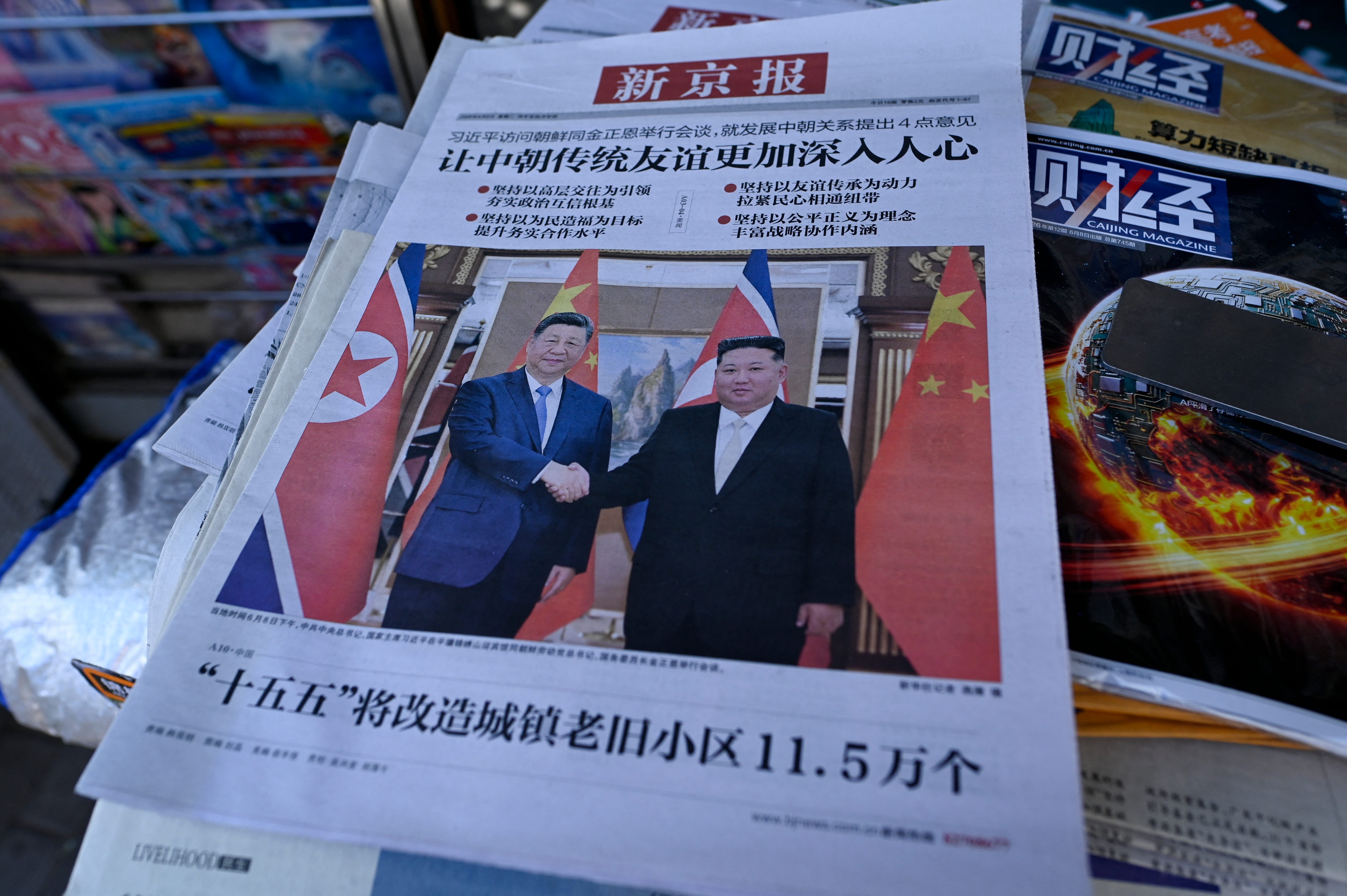
(Photo by WANG Zhao/AFP via Getty Images)
What Happened
China’s leader Xi Jinping has wrapped up a two-day visit to Pyongyang, his first official trip to North Korea in seven years. During the summit, Xi expressed that the two countries should strengthen strategic cooperation and exchanges in the fields of diplomacy, law enforcement, and the military. The trip comes amidst a flurry of diplomatic engagements for Xi: less than a month ago, he hosted Donald Trump in Beijing to discuss trade tensions, Taiwan, the U.S.-Israeli war with Iran, and North Korea. Just four days after that, Vladimir Putin arrived in Beijing for a meeting that revealed friction despite claims that Russia-China ties are at a “historic high.”
In this latest edition of Asia ASAP, Asia Society Policy Institute experts unpack the Xi-Kim summit and implications for Washington, Seoul, Moscow, and beyond.
All Roads Run Through Beijing
In 2018, as he was preparing for a meeting with President Trump, Kim Jong Un boarded his armored train for the 20-hour ride to meet with Xi Jinping. The message from both Kim and Xi to the U.S. president seemed clear: the path to better relations between Washington and Pyongyang ran through Beijing. Now, with rumors that Trump might want to re-engage with the North Korean leader, a recalibrated signal was sent: China’s influence is still supreme and, this time, China was mum on denuclearization.
For years, China’s desire to prevent North Korea from developing its nuclear weapons program compelled it to cooperate, intermittently and with significant limitations, with the United States and others to use its leverage over Pyongyang. Xi may have now calculated that the regime has advanced its capabilities so far that denuclearization is no longer feasible and, in the meantime, Kim has gained a new patron in and possibly sophisticated missile technology from Moscow. If the United States wants to make a deal with North Korea, will nuclear disarmament be on the table, if Washington cannot count on Chinese support for that position?
For Seoul and Tokyo—already marginalized, belittled, and shunned by Pyongyang—the summit further deepened their isolation from the diplomatic process, even as they remain the most threatened by the DPRK’s capabilities. The regime and its mouthpieces reiterated Xi’s positions on Japan—specifically on its recent relaxation of arms exports and Japan Prime Minister Takaichi’s comments on Taiwan—hardening the united bloc against Tokyo. And ahead of Xi’s arrival, Kim’s publicized visits to a nuclear facility and aboard a destroyer served as a reminder to both Seoul and Tokyo of the DPRK’s advancements, indicating no appetite to negotiate.
Xi’s Visit May Trigger a Reduction of Russian Influence over Pyongyang
By Lyle Morris
Xi Jinping’s visit to North Korea may bring about a modest but important reduction in Russian leverage over Pyongyang. While the visit does not erase the substantial influence Moscow has amassed since their mutual defense treaty was signed in 2024, it offers Kim the opportunity to diversify North Korea’s foreign relations away from Moscow to a more balanced triangular dynamic that maximizes North Korea’s strategic autonomy. In this sense, the primary beneficiary may be Pyongyang itself, which gains greater flexibility by avoiding excessive dependence on either partner while extracting political, economic, and security benefits from both.
If Chinese re-engagement proves durable, Russia could lose some of the advantages it accumulated between 2022 and 2026, when deteriorating China–North Korea relations increased Pyongyang’s reliance on Moscow. The Xi-Kim summit will likely expand Chinese trade, food, and energy assistance, as well as high-level diplomatic exchanges, with the DPRK. This will inevitably reduce Russia’s role as North Korea’s principal source of external support. Moreover, renewed Xi-Kim engagement reinforces China’s longstanding position as North Korea’s most important strategic partner. China is North Korea’s largest trading partner and the actor with the greatest influence to ease Western sanctions against the DPRK. These structural advantages cannot be easily replaced by Russia.
A more competitive environment between Beijing and Moscow would also strengthen North Korea’s bargaining position. Kim can seek aid and concessions from both capitals— in essence playing each against the other in a manner similar to the Cold War. At the same time, deeper Chinese engagement could increase Beijing’s ability to shape North Korean decisions on issues such as denuclearization along the Peninsula, missile testing, regional provocations, diplomacy with the United States, and economic policy, among other issues.
Setting the Stage for a Trump-Kim Summit?
By Sungmin Cho
During his meeting with North Korean leader Kim Jong Un, Xi Jinping emphasized that China and North Korea should “consolidate the foundation of political mutual trust and enhance the level of practical cooperation.” The rest of his and Kim’s remarks were crafted to make the same point: the re-strengthening of China–North Korea ties. However, the strategic message is reflected not in the words, but in the act of Xi’s visit itself and its timing.
It is noteworthy that this is Xi’s first trip abroad this year. Some analysts claim that Xi is merely reciprocating Kim’s August 2025 trip to Beijing. However, in 2019, Xi visited Pyongyang only after Kim had already visited China four times. Even U.S. President Trump and Russia’s Vladimir Putin traveled to Beijing to meet Xi Jinping. When Xi took the trouble to visit Pyongyang himself, there must have been motivations beyond simply consolidating bilateral ties with Kim’s North Korea.
It is no secret that the relationship with the United States is the most important one to China. It is also well known that President Trump has been eager to engage with Kim Jong Un. Before visiting South Korea for the APEC summit last November, Trump said that he would like to meet Kim. When leaving South Korea, he stated, “I will come back and talk to Kim Jong Un.” During the Trump-Xi summit in Beijing, the readouts from both governments confirmed that the two leaders discussed the North Korean issue. It is highly plausible that Trump spoke with Xi about what he has already stated many times in public: his interest in engaging with Kim.
During their meetings this week, it is likely that Xi and Kim discussed President Trump’s interest in meeting with Kim. Through a summit with Trump, Kim may try to get Trump to downplay the goal of denuclearization and move instead toward practical negotiations on arms control, which would in effect treat North Korea as a nuclear state. By playing the role of broker, Xi could also seek a price in return—whether in the form of reduced U.S. coordination with Japan regarding Taiwan contingencies or potential concessions on Taiwan-related issues.
From the perspectives of Xi and Kim, Trump is the only U.S. president with whom they might be able to strike a deal on such sensitive issues. That is not to say that Beijing and Pyongyang will offer a Trump-Kim dialogue anytime soon. However, it is a possibility that has become more plausible after Xi’s visit to Pyongyang.
Dive Deeper with ASPI
Read the latest analysis from ASPI’s Center for China Analysis on “Russia-North Korea Military Cooperation Response to China’s Tactical Ambiguity,” by Sungmin Cho.
Last month, ASPI hosted a conference on “The U.S.-ROK Alliance in 2026,” featuring panel discussions on “The U.S.-South Korea Partnership in an Era of Strategic Competition” and “How the U.S.-ROK Alliance is Adapting to New Security Realities.” ROK Consul General Sangho Kim delivered opening remarks, and Asia Society President & CEO Kevin Rudd gave closing remarks on “The Future of the U.S.-ROK Alliance and Indo-Pacific Security.”
In his first public event in his new role, Asia Society’s 10th Global President and CEO Kevin Rudd joins Ian Bremmer for a comprehensive discussion on the future of U.S.-China relations and the wider geopolitical opportunities and challenges shaping the global landscape.